


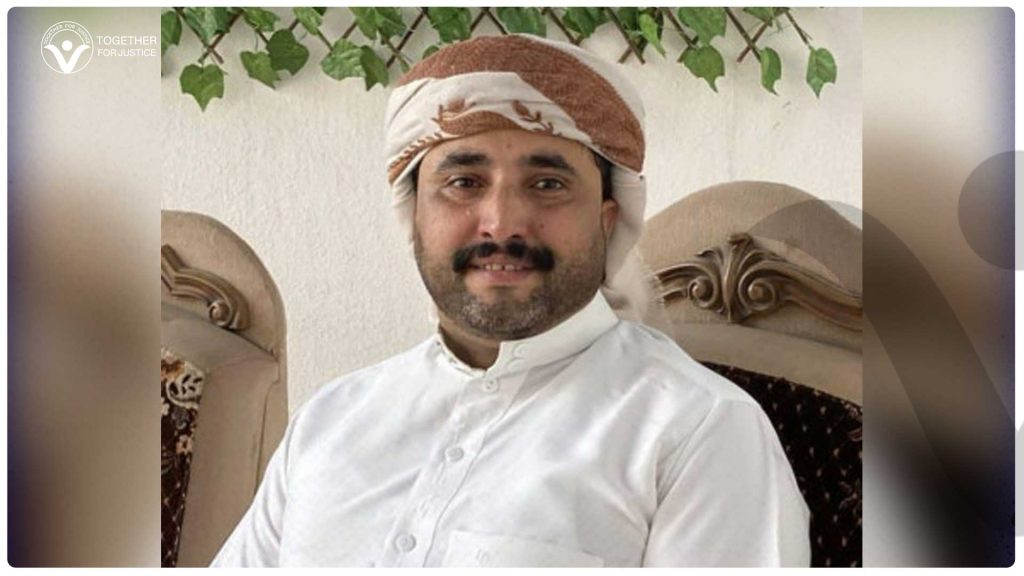
Together for Justice condemns the Saudi authorities’ decision in May 2026 to uphold the unjust 15-year prison sentence against Yemeni journalist Ali Mohsen Abu Luhom, who has been detained since August 2021 in Najran over tweets allegedly posted from fake accounts that he has repeatedly denied owning or operating.
Abu Luhom was arrested on 23 August 2021 outside his home in Najran, before being prosecuted and sentenced to 15 years in prison. His case, documented by Human Rights Watch, raises serious concerns about the lack of transparency, the absence of fair trial guarantees, and the growing use of vague digital accusations to punish journalists and silence public expression.
The seriousness of this case lies not only in the length of the sentence, but in the nature of the accusation itself. Saudi authorities have imposed a severe prison term on a Yemeni journalist based on tweets allegedly linked to anonymous or fake accounts, despite his denial of any connection to them. No transparent and verifiable evidence has been made public to justify such a harsh sentence.
Together for Justice stresses that turning unidentified digital content into the basis for a 15-year prison sentence reflects a dangerous expansion in the use of online accusations as tools of punishment. In a fair legal system, criminal responsibility must be based on clear, direct, and verifiable evidence, not vague claims about anonymous accounts or unproven digital activity.
Abu Luhom’s case also reflects a broader pattern of cross-border repression in Saudi Arabia. The kingdom’s crackdown is no longer limited to Saudi citizens; it also affects residents, foreign nationals, journalists, and workers from other countries who live or work inside Saudi territory. The message is clear: any independent voice, or anyone suspected of challenging the official narrative, may become a target for prosecution and imprisonment.
The imprisonment of a Yemeni journalist in Saudi Arabia over tweets he denies writing raises urgent questions about judicial independence, the misuse of cybercrime and security-related laws, and the transformation of the courts into instruments for expanding state control over digital expression.
The decision to uphold the sentence in May 2026, despite serious doubts surrounding the legal basis of the case, shows an official insistence on maintaining an unjust punishment rather than addressing the violations that have marked the case from the beginning. Justice is not served by confirming harsh sentences; it is served by ensuring transparency, due process, access to evidence, and the right to a full defence.
Together for Justice emphasizes that journalism is not a crime, and digital expression must not be used as a pretext to imprison journalists for years, especially when the case is built on posts the defendant denies. Using unclear or unproven accusations to imprison a Yemeni journalist in Saudi Arabia is a grave violation of the right to liberty, freedom of expression, and fair trial guarantees.
Together for Justice calls on the Saudi authorities to overturn the sentence against Ali Mohsen Abu Luhom, release him immediately and unconditionally, allow him access to his family and legal counsel, and disclose his current health and legal status.
Together for Justice further calls for an independent and transparent review of his case, including the disclosure of the evidence used against him, and accountability for any violations committed during his arrest, detention, or trial.
Ali Mohsen Abu Luhom should not spend 15 years of his life behind bars over tweets allegedly posted from fake accounts he denies owning. His case exposes a dangerous reality: in Saudi Arabia, a digital accusation can become a long prison sentence, and a foreign journalist can be deprived of freedom without the transparency and justice required by law.