


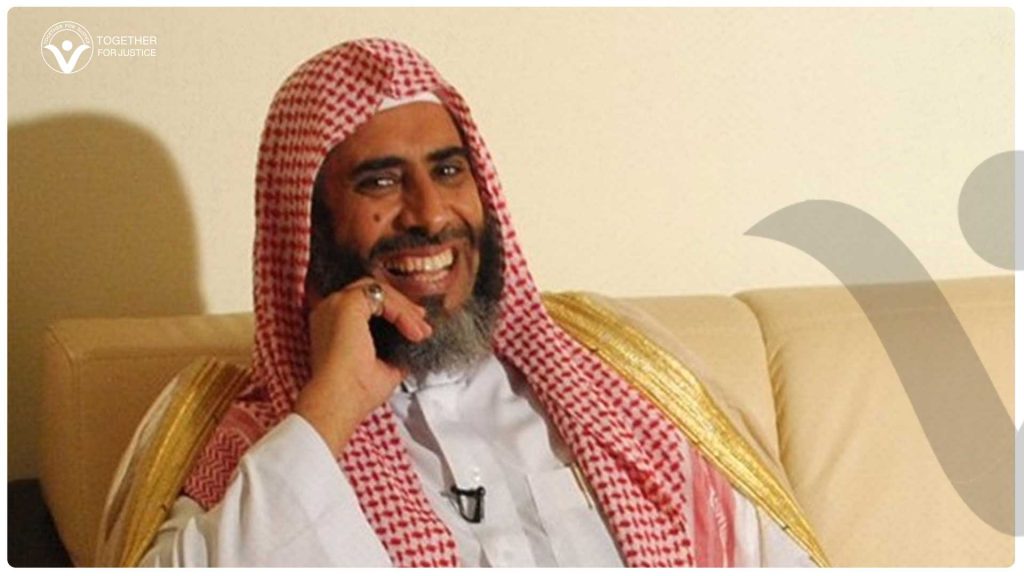
Together for Justice condemns the continued detention of Sheikh Dr. Awad Al-Qarni, a 69-year-old Saudi academic and preacher, who has been held since his arrest during the September 2017 crackdown. His case exposes the extent to which peaceful expression in Saudi Arabia can be transformed into a security case ending with a demand for execution.
The seriousness of the case has been reinforced by revelations from his son, who stated that his father has spent the entirety of his detention — now reaching 3,226 days — in solitary confinement, inside a cell measuring less than two meters by two meters. He was reportedly denied even the right to attend Friday prayers in the prison mosque. These details do not describe ordinary harsh detention conditions; they point to a prolonged and deliberate pattern of psychological and physical abuse.
Al-Qarni was arrested as part of a wide campaign targeting scholars, preachers, academics, intellectuals, and independent opinion-holders in Saudi Arabia. Since 2017, his case has not been treated as a matter of peaceful expression, but as a serious security file, even though the core of the accusations against him relates to tweets and peaceful digital activity.
The charges reportedly center on his use of social media, including his verified Twitter account under his real name, communication through applications such as WhatsApp and Telegram, and the posting or sharing of views and material related to public, religious, and political affairs. These acts fall within the core of the right to freedom of opinion and expression. They must not be converted into charges that justify imprisonment, let alone a demand for the death penalty.
The Saudi Public Prosecution’s pursuit of execution over tweets and peaceful digital expression represents an extremely dangerous escalation against freedom of expression. The message is not directed at Al-Qarni alone; it is aimed at every independent voice who may now understand that a word online can become a court file threatening their life.
Together for Justice stresses that the prolonged solitary confinement imposed on Al-Qarni constitutes a grave violation of the United Nations Standard Minimum Rules for the Treatment of Prisoners, known as the Mandela Rules, which recognize prolonged solitary confinement as a form of cruel, inhuman, or degrading treatment. If sustained over all these years, what Al-Qarni has endured goes far beyond “prolonged isolation”; it amounts to a systematic policy aimed at breaking a person physically and psychologically.
The violation is even more alarming given his age and the likely health consequences of years of isolation. Holding a 69-year-old man in a narrow solitary cell, depriving him of normal movement, sunlight, regular human contact, communal prayer, and adequate medical care, places direct responsibility on the Saudi authorities for any deterioration in his physical or mental health.
The reported denial of Friday prayers, even inside the prison mosque, shows that the punishment has extended beyond deprivation of liberty to the denial of a basic religious right. Prison administration or security measures must not be used as a pretext to strip detainees of their religious and human rights, especially in the absence of clear and lawful justification.
Al-Qarni’s case is part of a broader pattern in Saudi Arabia, where the digital sphere has become a source of prosecution rather than a space for expression. Many prisoners of conscience have faced harsh sentences over tweets, reposts, messages, or peaceful opinions, in a clear misuse of security and counterterrorism frameworks to punish independent speech.
Together for Justice emphasizes that any judicial process based on opaque proceedings, possible coerced statements extracted under harsh conditions, or accusations linked to peaceful expression cannot be considered fair or legitimate. The danger becomes even more severe when the potential outcome is an irreversible punishment such as execution.
From a human rights perspective, Al-Qarni’s case involves multiple serious violations: arbitrary detention, prolonged solitary confinement, deprivation of basic religious and human rights, denial of fair trial guarantees, and the threat of execution over the exercise of freedom of expression. These violations do not only affect one individual; they expose a deeper crisis within Saudi Arabia’s politicized justice system.
Together for Justice holds the Saudi authorities fully responsible for Sheikh Dr. Awad Al-Qarni’s life and physical and psychological safety. The organization calls for an immediate end to any demand for his execution and for all charges linked to his tweets, opinions, and peaceful digital activity to be dropped.
The organization also calls for his immediate and unconditional release, an immediate end to his solitary confinement, regular access to his family and legal counsel, independent medical care, and full respect for his right to practice his religion without retaliation or arbitrary restriction.
Together for Justice urges the United Nations and its special procedures on torture, extrajudicial executions, freedom of opinion and expression, and arbitrary detention to intervene urgently in his case, pressure the Saudi authorities to stop using the death penalty against opinion-holders, and open an independent investigation into his detention conditions and years of solitary confinement. Awad Al-Qarni did not carry a weapon, did not call for violence, and did not commit a crime warranting death. The accusations against him revolve around words, tweets, and digital communication. After 3,226 days in a narrow solitary cell, his case stands as evidence of a state that fears speech so deeply it seeks to execute the speaker.