


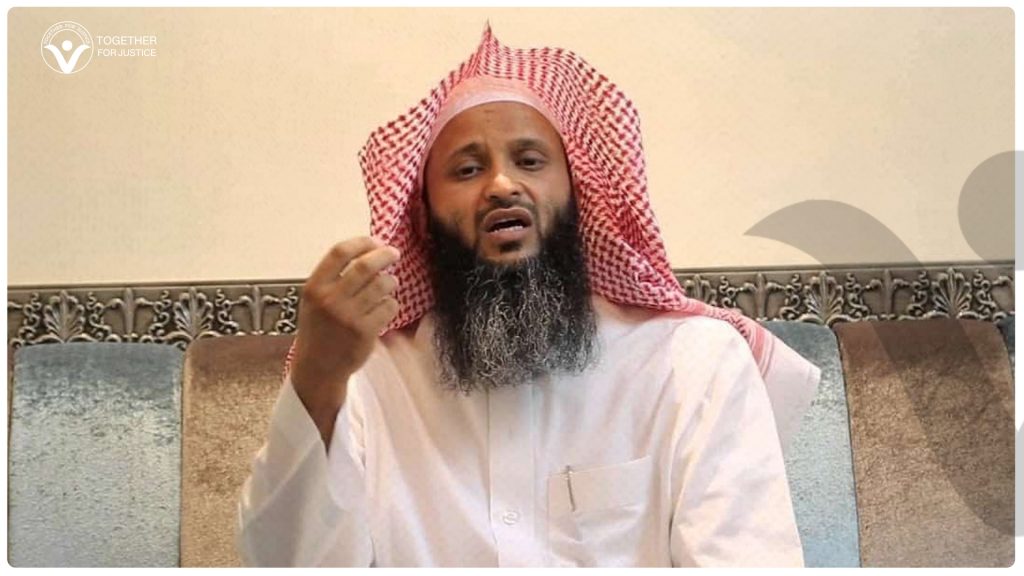
Saudi preacher Mohammed Al-Shannar has remained in detention since September 2017, nearly nine years after he was arrested during the sweeping crackdown that targeted preachers, academics, writers, activists, and independent voices across Saudi Arabia.
From the earliest days of his detention, Al-Shannar’s case has been marked by serious human rights violations. Saudi authorities cut off all communication between him and his family for five consecutive months following his arrest. Reports concerning his case also indicate that he was subjected to humiliation and torture and denied the right to appoint a lawyer.
He remains detained to this day over vague accusations, including “inciting public opinion,” raising serious concerns that his prolonged detention is connected to the peaceful exercise of freedom of expression rather than any recognisable criminal offence.
Together for Justice warns that the continued detention of Mohammed Al-Shannar, combined with the abuses reported since his arrest, requires urgent intervention by relevant United Nations mechanisms. His case must not be allowed to disappear into the wider record of repression that followed the September 2017 crackdown.
Five Months Cut Off From His Family
One of the first violations Al-Shannar endured following his arrest was his complete isolation from his family.
For five consecutive months, Saudi authorities prevented all forms of communication between Al-Shannar and his relatives, leaving his family unable to speak to him, verify his safety, or obtain adequate information about the circumstances of his detention.
Such prolonged isolation cannot be treated as a routine administrative measure. Holding a detainee without meaningful contact with the outside world removes crucial safeguards against abuse and leaves the individual particularly vulnerable to torture and other forms of ill-treatment.
It also inflicts severe distress on relatives who are left without reliable information about the safety and treatment of their detained family member.
The circumstances surrounding this period therefore raise serious concerns about the protections afforded to Al-Shannar during the initial months of his detention.
Reports of Torture and Humiliation
Al-Shannar was also reportedly subjected to physical and psychological torture, humiliation, and degrading treatment during his detention. These allegations require an independent and effective investigation.
Saudi Arabia is a state party to the United Nations Convention against Torture, which establishes an absolute prohibition on torture and requires states to prevent, investigate, and ensure accountability for acts of torture and other cruel, inhuman, or degrading treatment or punishment. No security or political justification can legitimise such treatment.
The allegations are particularly concerning given that Al-Shannar was initially isolated from his family and denied access to legal representation, creating conditions in which abuse could occur away from meaningful external scrutiny.
Years later, there has been no transparent accountability for the violations reportedly committed against him.
Denied Access to Legal Representation
Al-Shannar was also denied the right to appoint a lawyer, undermining one of the most fundamental safeguards available to any person deprived of liberty.
Access to legal counsel is not merely a procedural formality. It enables detainees to understand the accusations against them, challenge the legality of their detention, prepare an effective defence, and seek protection against abuse.
This safeguard becomes particularly important when a detainee faces vaguely formulated accusations related to speech or public expression.
In Al-Shannar’s case, the combination of isolation from his family, denial of legal representation, allegations of torture and prolonged detention raises profound concerns regarding the fairness and legality of the proceedings against him.
“Inciting Public Opinion”: Vague Charges Used Against Expression
Among the accusations reportedly brought against Mohammed Al-Shannar is “inciting public opinion.”
Such broadly formulated accusations are deeply problematic when they are used to criminalise peaceful speech.
Criminal law should not be used to punish individuals simply for expressing opinions, discussing public affairs, criticising policies, or communicating views that authorities find inconvenient.
After years behind bars, Al-Shannar’s case has become part of a broader pattern of restrictions on freedom of expression in Saudi Arabia, where vaguely worded accusations have repeatedly been used against peaceful critics, activists, writers, religious figures, and other independent voices.
A government cannot transform peaceful expression into a security offence merely by attaching an ambiguous label to it.
Years of Detention Demand Accountability, Not Silence
Mohammed Al-Shannar has now spent years deprived of his liberty since his arrest in September 2017.
The passage of time does not diminish the seriousness of what he has endured.
His case encompasses prolonged separation from his family, allegations of torture and humiliation, denial of access to legal counsel, and detention linked to vague accusations concerning public expression.
Together for Justice stresses that prolonged detention must never become a mechanism through which serious violations are gradually forgotten.
Saudi authorities must provide full transparency regarding Al-Shannar’s current legal status and conditions of detention, guarantee his fundamental rights, and ensure an independent investigation into allegations of torture and other mistreatment. Those responsible for any violations must be held accountable.
Together for Justice Calls for Urgent UN Intervention
Together for Justice calls on relevant United Nations human rights mechanisms to urgently intervene in the case of Mohammed Al-Shannar.
In particular, the organisation urges the UN Working Group on Arbitrary Detention, the UN Special Rapporteur on Torture and Other Cruel, Inhuman or Degrading Treatment or Punishment, and the UN Special Rapporteur on the Promotion and Protection of the Right to Freedom of Opinion and Expression to examine his case and seek answers from the Saudi authorities.
Relevant UN mechanisms dealing with enforced disappearance should also examine the circumstances of the period during which Al-Shannar was held without communication with his family where the applicable legal criteria are met.
Together for Justice calls on these mechanisms to seek comprehensive information regarding Al-Shannar’s current circumstances, legal status, health and conditions of detention; demand an independent investigation into allegations of torture and ill-treatment; and ensure that he is granted regular family contact and immediate, effective access to independent legal counsel.
The organisation further calls on Saudi authorities to immediately and unconditionally release Mohammed Al-Shannar if his detention is based solely on the peaceful exercise of his fundamental rights, and to drop any charges arising exclusively from protected expression.
His case is not simply a legacy of the September 2017 crackdown. It remains an ongoing human rights concern for as long as he remains behind bars and the violations committed against him remain uninvestigated.
After years of detention, silence cannot be allowed to substitute for accountability. Saudi authorities must end his detention for peaceful expression, while UN bodies and the wider international community must use the mechanisms available to them to press for his freedom, investigate the abuses he has endured, and ensure that years of detention and alleged torture do not end without justice.