


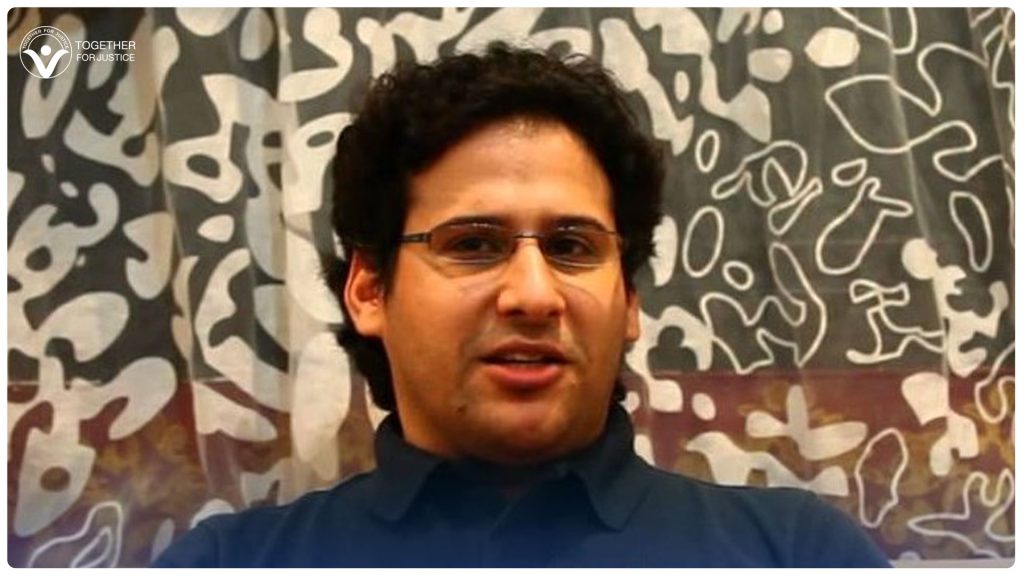
Together for Justice recalls the case of Saudi human rights lawyer Waleed Abu Al-Khair, who has been detained since 2014 and is serving an unjust 15-year prison sentence, as Saudi authorities renew their campaign to block the accounts of dissidents, activists, and human rights defenders from appearing inside the kingdom.
The current campaign, which has targeted Saudi opposition voices living abroad by withholding their accounts inside Saudi Arabia, is not new in substance. It is the continuation of a policy that Waleed Abu Al-Khair experienced years before his arrest: first, the authorities blocked his websites and social media pages; later, they placed him behind bars to block his voice entirely.
In an old televised interview from Jeddah, Abu Al-Khair spoke about the blocking of his Twitter page. He explained that the content that angered the authorities was not dangerous or criminal. It related to a legal case he had filed against the Ministry of Interior over the arbitrary detention of reformist lawyer Suleiman Al-Rashudi.
Abu Al-Khair made clear at the time that the issue was not one specific post. The real issue, he said, was that he was being pursued for everything he wrote online. He noted that this was the fourth time his online presence had been blocked, after previous censorship of websites and pages he supervised.
That interview now reads like an early warning. Abu Al-Khair said then that arrest had been expected for a long time, and that he had received repeated threats. He also revealed that individuals linked to the Ministry of Interior had warned his father and brother that he would soon be arrested. A few years later, those threats became reality.
His story exposes a clear pattern: the authorities begin by blocking pages, then monitor accounts, then threaten the person behind the voice, and eventually imprison them. Digital censorship is not separate from detention; it can be the first stage of it. The aim is the same in both cases: to prevent independent voices from reaching the public.
Today, as Saudi authorities push platforms to withhold the accounts of exiled dissidents and human rights defenders inside the kingdom, Waleed Abu Al-Khair’s experience becomes more relevant than ever. The government is still pursuing the same objective: preventing people inside Saudi Arabia from accessing reformist and human rights voices, whether those voices are inside the country or abroad.
The tools have changed, but the intention has not. Years ago, the authorities blocked websites and pages belonging to activists inside Saudi Arabia. Today, they ask global platforms to block the accounts of Saudi dissidents living abroad from being seen by users inside the kingdom. In both cases, the purpose is not to protect society; it is to isolate society from information, accountability, and independent narratives.
Waleed Abu Al-Khair understood this early. His words showed that the problem was not a single tweet or post, but the existence of an independent voice outside state control. That is still the core of Saudi Arabia’s approach to freedom of expression: the state does not merely object to content; it fears voices that cannot be controlled.
Together for Justice stresses that the current blocking campaign must be understood in light of what happened to Abu Al-Khair and other Saudi human rights defenders whose persecution began with digital censorship and ended in prison sentences. Blocking accounts is not a technical measure; it is part of a wider system of repression that uses censorship, isolation, intimidation, and imprisonment to close public space.
Waleed Abu Al-Khair paid the price for defending human rights, detainees, and legal reform in Saudi Arabia. The digital restrictions against him were a clear prelude to his later arrest, trial, and harsh sentence. Today’s new censorship campaign shows that Saudi authorities have not abandoned the policy of silencing independent voices; they have expanded it into the global digital sphere.
Together for Justice calls for the immediate and unconditional release of Waleed Abu Al-Khair, the annulment of the unjust sentence against him, and fair compensation for the years he has spent in prison.
The organization also calls for an end to the campaign blocking Saudi dissidents and human rights defenders from appearing inside the kingdom, full disclosure of all censorship requests sent to social media platforms, and respect for the right of people inside Saudi Arabia to access independent information and human rights voices without digital isolation.
Waleed Abu Al-Khair’s story makes one thing clear: censorship does not stop at blocking a page. When an authoritarian state cannot tolerate a voice, it first blocks it online — then imprisons the person behind it. What is happening today shows that the struggle in Saudi Arabia is not only for the freedom of those behind bars, but also for society’s right to hear them and hear those who continue to defend them.