


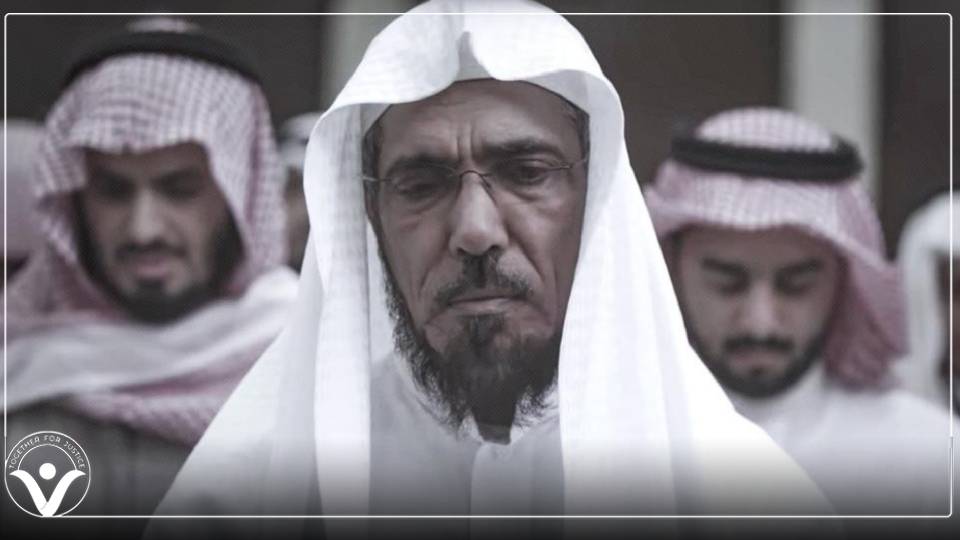
Together for Justice renews its grave concern over the continued detention of prominent Saudi scholar and academic Sheikh Salman Al-Odah, who has been imprisoned since September 2017 and is now approaching nine years behind bars without a final verdict, without meaningful fair trial guarantees, and under detention conditions that continue to deteriorate.
Al-Odah’s case is no longer merely a delayed judicial file. It has become a clear example of how prolonged imprisonment, solitary confinement, and medical neglect are used as instruments of punishment against independent voices in Saudi Arabia. Since his arrest during the September 2017 crackdown on scholars, academics, and public intellectuals, Al-Odah has remained in harsh detention conditions, with severe restrictions on his contact with his family and legal counsel, while his case has remained suspended for years without a transparent legal resolution.
Available information regarding his detention conditions points to prolonged isolation in Al-Ha’ir Prison, alongside a worsening health condition, including reported vision problems and other chronic medical concerns, amid a lack of adequate medical care. His son, academic and human rights advocate Abdullah Al-Odah, has previously reported that his father was subjected to harsh prison conditions, including being denied basic items needed to protect him from extreme cold inside his cell — a sign of the deliberate neglect he continues to face.
Prolonged solitary confinement, combined with denial of medical care and restrictions on normal family contact, cannot be treated as an administrative or precautionary measure. In such circumstances, it amounts to cruel and inhuman treatment and may fall within the scope of torture prohibited under international law, particularly when used over many years to weaken a detainee physically and psychologically.
The gravity of the case is further heightened by the Saudi Public Prosecution’s continued demand for the death penalty against Sheikh Salman Al-Odah on the basis of politically motivated charges linked to his views and public positions. Despite the passage of years since the last known court hearings in his case, the proceedings remain unresolved, depriving him of the right to have his case decided within a reasonable time and leaving him under the constant threat of execution without a transparent judicial process.
Together for Justice also condemns the Saudi authorities’ refusal to allow independent United Nations mechanisms to examine Al-Odah’s health and detention conditions, including the denial of access to the UN expert on the rights of older persons. This refusal reflects a clear effort to keep prison conditions hidden from international scrutiny and to deprive detainees of independent protection.
From a legal perspective, the continued detention of Salman Al-Odah without a final judgment, the denial of fair trial guarantees, prolonged solitary confinement, and medical neglect constitute direct violations of the right to liberty and security of person, the right to a fair trial, the right to health, and the prohibition of torture and ill-treatment. The demand for his execution over peaceful views further exposes the use of the judiciary as a tool to suppress public debate and silence religious and intellectual figures who do not align with the official narrative.
Together for Justice stresses that Al-Odah’s case cannot be separated from the broader campaign targeting scholars, preachers, academics, and intellectuals since Mohammed bin Salman became Crown Prince. Under this approach, freedom of opinion has been treated as a security threat, and silence — or public alignment with the authorities — has become the price of avoiding imprisonment, smear campaigns, and politically driven trials.
The organization further notes that limited and selective releases announced by Saudi authorities do not change the substance of the human rights situation while prominent prisoners of conscience, including Salman Al-Odah, Awad Al-Qarni, Ali Al-Omari, and others, continue to face prolonged imprisonment or the threat of execution because of their views.
Accordingly, Together for Justice calls for the immediate and unconditional release of Sheikh Salman Al-Odah, the dropping of all politically motivated charges against him, the immediate end of his solitary confinement, and urgent access to independent and adequate medical care.
The organization also calls on Saudi authorities to allow UN mechanisms and independent human rights organizations to visit detention facilities, assess the conditions of prisoners of conscience, and ensure accountability for those responsible for torture, denial of medical care, and the use of the judiciary to prolong arbitrary detention.
Nearly nine years of isolation, the threat of execution, and medical neglect cannot be described as a judicial process. They constitute a prolonged political punishment. The continued detention of Salman Al-Odah in these conditions confirms that official claims of reform and openness remain contradicted by the reality of Saudi prisons, where independent voices are left in isolation for refusing to become part of a single narrative imposed by force.