


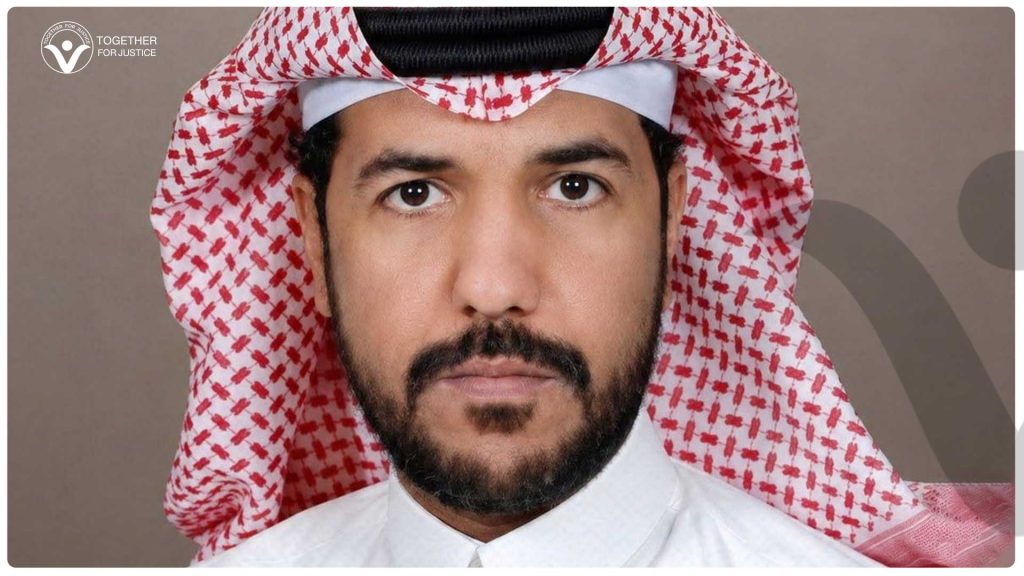
Together for Justice condemns the continued detention of Saudi human rights activist Khaled Al-Omair, one of the most prominent Saudi voices supporting the Palestinian cause, who was re-arrested in June 2018 after filing an official complaint with the Royal Court about torture and ill-treatment he said he had suffered during a previous detention.
Al-Omair’s case exposes one of the most serious failures of justice in Saudi Arabia: the victim is not protected, but punished; the violation is not investigated, but the act of reporting it becomes a reason for further retaliation. Instead of opening an independent inquiry into his torture allegations, the authorities re-arrested him, turning his attempt to seek redress into another stage of punishment.
Khaled Al-Omair was not known for violence or incitement. He was known for peaceful human rights activism, support for the Palestinian cause, and calls for political and legal reform. These positions fall within the core of freedom of opinion and expression, yet the Saudi authorities treated them as a threat to be silenced.
The background to the case goes back to an earlier detention during which Al-Omair reportedly suffered torture and ill-treatment. After his release, he chose a formal legal route and submitted a complaint to the Royal Court, requesting an investigation and accountability. In any system that respects the law, such a complaint should have triggered an inquiry. In Saudi Arabia, it led to his re-arrest in June 2018.
Following proceedings marked by serious concerns over transparency and fair trial guarantees, Al-Omair was sentenced to prison. The court later increased his sentence from seven years to nine years. This escalation cannot be separated from the broader context of retaliation against an activist who tried to expose abuse, nor from the wider use of Saudi courts to punish peaceful opinion rather than protect rights.
The seriousness of Al-Omair’s case is not limited to the sentence or the length of his detention. It also includes the harsh human deprivation imposed on him while in prison. He was reportedly denied the chance to say goodbye to his father before his death, and was also prevented from visiting his sick mother. These measures show that the punishment has extended beyond imprisonment to the deliberate breaking of family ties and psychological pressure on the detainee.
Denying a detainee the right to bid farewell to a dying parent or visit a sick mother serves no legitimate legal purpose. It is a form of cruelty. Family contact, particularly in cases of illness and death, is not a privilege to be granted or withheld arbitrarily by prison authorities; it is a basic human right.
Together for Justice stresses that arresting Khaled Al-Omair after he filed a complaint about torture sends a dangerous message to victims of abuse inside Saudi Arabia: those who report violations may themselves be punished, and those who demand accountability may become the accused. This destroys the very idea of justice and turns state institutions into tools that protect perpetrators rather than victims.
His case also reflects a broader pattern of targeting human rights activists and those who express solidarity with just causes, including Palestine. While Saudi authorities promote an image of reform and openness abroad, they continue to imprison independent voices at home, particularly those whose activism connects domestic rights with broader regional human rights causes.
From a legal perspective, Al-Omair’s continued detention over peaceful activism, and the retaliation he faced after filing a torture complaint, violate his right to liberty and security of person, his right to freedom of opinion and expression, his right to an effective remedy, and his right to protection from torture and cruel or inhuman treatment.
Together for Justice holds the Saudi authorities fully responsible for Khaled Al-Omair’s physical and psychological safety. The organization calls for his immediate and unconditional release, the annulment of the sentence issued against him, and full respect for his legal and human rights.
The organization also calls for an independent and transparent investigation into the torture and ill-treatment allegations he reported, accountability for all those involved or complicit, and an end to the policy of punishing victims and whistleblowers who report abuse.
Together for Justice urges the United Nations and its special procedures, particularly those concerned with torture, arbitrary detention, and freedom of opinion and expression, to follow his case and pressure the Saudi authorities to end his detention and stop using the judiciary as a tool of retaliation against activists and those demanding accountability. Khaled Al-Omair’s case is not only the case of a prisoner of conscience. It is the case of a victim punished for reporting torture. After years behind bars, his continued imprisonment remains evidence of a system in which seeking justice is criminalized, perpetrators are shielded, and those who refuse silence are punished.