


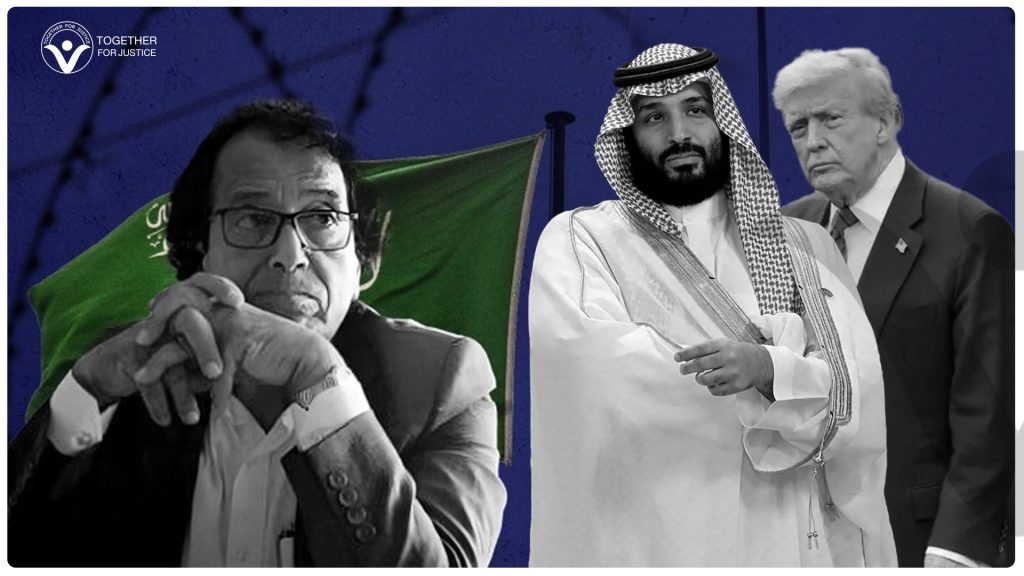
In two days, Saudi Crown Prince Mohammed bin Salman will walk into the White House for a high-profile meeting with President Donald Trump—an encounter presented as a strategic milestone for defense cooperation, economic alignment, and geopolitical coordination. Yet behind the choreography of official receptions and the language of “strengthening ties,” one fact remains glaring and impossible to ignore: the visit is taking place despite a documented pattern of human rights violations, despite ongoing international criticism, despite hundreds of prisoners of conscience inside Saudi Arabia, and despite the continued detention of a U.S.–Saudi citizen over fourteen tweets posted from his home in Florida.
This contradiction—the celebration of diplomatic partnership alongside the normalization of repression—defines the political moment surrounding the visit.
The case of Saad Ibrahim Almadi, a 75-year-old retired project manager and dual U.S.–Saudi national, embodies this contradiction with painful clarity. Almadi traveled from Florida to Riyadh in November 2021. Upon landing, he was arrested by Saudi agents and charged with “terrorism,” “destabilizing the Kingdom,” and “harboring extremist ideology”—all based on fourteen social media posts written years earlier on his private X (formerly Twitter) account. None of these posts advocated violence, supported extremist groups, or called for unlawful action. Several were simple social observations; others were mild criticisms of governance; some were even humorous.
Yet for these harmless expressions, Almadi was wrongfully detained, brought before the Specialized Criminal Court, sentenced, and placed under a travel ban that to this day prevents him from returning to the United States. His life has been effectively suspended—imprisoned first, then trapped inside the Kingdom afterward—because of comments typed on a phone.
His son, Ibrahim Almadi, has spent the last four years fighting for his father’s release, traveling between Florida and Washington D.C., speaking to officials, and pushing the case into the public eye. He describes the suffering as “beyond expression,” pointing to the immense power imbalance and the impunity with which the Saudi authorities detain not only their own citizens but even American nationals.
Meanwhile, the response from Washington—across administrations—has been disappointingly hollow. Statements that the President is “aware of the case” or that discussions “may occur in due time” stand in stark contrast to the urgency of a 75-year-old man detained for tweets. And now, as Mohammed bin Salman prepares to enter the White House, Almadi’s case remains unresolved, his mobility restricted, and his future uncertain.
Human rights organizations in the United States, including the James W. Foley Foundation, have been vocal: Alamdi is not a threat, not a criminal, and not linked to any extremist ideology. His imprisonment is an assault on free expression. They have called on President Trump to raise the case directly with the Crown Prince—insisting that such a request “would not be ignored.”
Yet the broader scene surrounding this visit speaks to something deeper: a political relationship that is increasingly insulated from accountability, where defense deals, arms negotiations, and strategic calculations outweigh fundamental questions about human dignity and the rule of law. The normalization of dialogue with a leadership responsible for widespread repression—detentions, travel bans, excessive sentences, and documented abuses—sends a message that the suffering of ordinary people is a manageable side cost of geopolitical partnership.
This is not simply a diplomatic oversight. It is a political choice.
As MBS arrives in Washington in 48 hours, the question that hangs over the visit is not whether an agreement will be signed, or whether F-35 talks will advance, but whether the United States will continue to overlook the detention of its own citizen—and the repression of countless others—in exchange for the promise of strategic cooperation.
If the White House wishes to demonstrate that American citizenship, freedom of expression, and human rights still hold meaning, then it must confront the issue directly and insist on the release of Saad Almadi—not after the meeting, not in future negotiations, but now.
Otherwise, the message to authoritarian governments everywhere will be unmistakable: jailing an American citizen carries no political cost.