


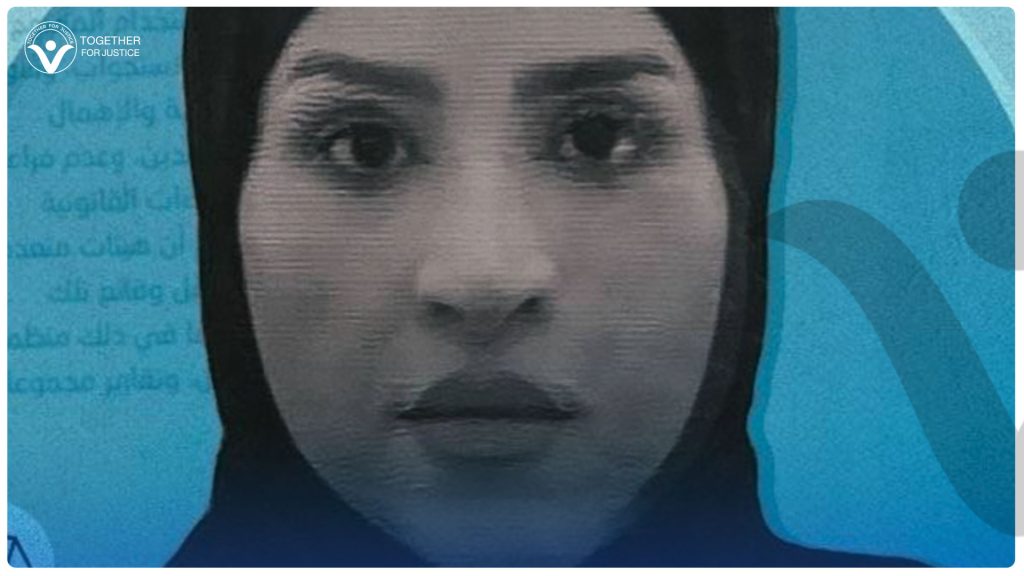
Together for Justice expresses its grave concern over the Saudi authorities’ continued detention of activist Najwa Ahmed al-Humaid since 16 May 2021 over her peaceful activity on social media, without transparent public information about her legal status or any sentence imposed against her.
Al-Humaid has now spent more than 1,900 days behind bars. Security forces raided her family home, confiscated her books and electronic devices, and arrested her before she was subsequently transferred to al-Tarafiya Prison in the al-Qassim region.
Al-Humaid was not known to have advocated violence or committed any act threatening public safety. Her activity consisted of engaging with matters of public interest on Twitter, now known as X, including unemployment, the detention of prisoners of conscience and human rights.
The authorities had summoned her for questioning several times before her final arrest, holding her for 14 days on one occasion. During the third incident, security forces raided her family’s home and detained her, demonstrating the authorities’ determination to transform peaceful online activity into a security case.
According to available information, al-Humaid faced vaguely worded allegations, including “dealing with suspicious entities” and following opposition accounts on social media. Following public accounts or engaging in social debate cannot constitute a crime in any legal system that respects freedom of opinion and expression.
Such broad accusations enable the authorities to criminalise ordinary online behaviour and punish individuals merely for accessing opposition views or expressing solidarity with victims of human rights violations. They also create a climate of surveillance and fear in which people feel compelled to censor even their most basic digital activity.
A television appearance that raises serious questions
News of al-Humaid disappeared following her arrest until she appeared in April 2022 in a report broadcast by the state-run Al Ekhbariya channel from inside al-Tarafiya Prison. During the segment, she spoke positively about detention conditions and the prison administration.
The channel identified her as a prisoner but provided no clear information about the charges against her, the court responsible for her case, or the length and basis of any sentence imposed.
Statements made by a detainee inside a government prison and under the supervision of the authorities responsible for her detention cannot be treated as independent testimony or reliable evidence of her actual conditions.
A prisoner speaking in such circumstances is not operating in a free environment, and there are no safeguards demonstrating that she was able to refuse the appearance or express views that contradicted the official narrative promoted by the report.
The use of al-Humaid in media material intended to present Saudi prisons positively raises serious questions about her free and informed consent, the circumstances in which the interview was recorded, and whether she faced direct or indirect pressure to participate.
Instead of presenting a tightly controlled television appearance as evidence of good treatment, the authorities should have allowed al-Humaid free and regular communication with her family and lawyer, disclosed her legal status, and granted independent monitors access to her place of detention.
Secrecy as part of the violation
More than five years after al-Humaid’s arrest, publicly available information about her case remains extremely limited. It is unclear when her trial began, what evidence was presented against her, whether she had access to an independent lawyer, what sentence may have been imposed, and whether she was given a genuine opportunity to appeal.
This lack of transparency is not a minor procedural concern. It is an essential part of the violation.
Secrecy surrounding detention prevents public scrutiny, makes it impossible to verify whether the detainee’s rights are being respected, and leaves her family in a prolonged state of anxiety and uncertainty.
Her continued imprisonment over peaceful online activity is also grossly disproportionate, regardless of any vague security label the authorities may attach to the case.
A case exposing Saudi Arabia’s persecution of women
Najwa al-Humaid’s case forms part of a wider campaign targeting Saudi women over tweets, online posts and peaceful human rights demands. Saudi authorities have used counterterrorism and cybercrime laws to impose severe punishment on women who expressed opinions, supported prisoners of conscience or called for social reform.
These cases expose the deep gap between official claims of women’s empowerment and a reality in which women are imprisoned for a tweet, following an opposition account or discussing social issues affecting their lives and communities.
Women’s empowerment cannot be reduced to permission to work, drive or attend public events. It begins with recognising women as full citizens who have the right to think, speak, criticise government policies and participate in public life without fear of home raids and imprisonment.
Her continued detention violates freedom of expression
The Universal Declaration of Human Rights protects freedom of opinion and expression, including the right to hold opinions and to seek, receive and communicate information and ideas.
The Arab Charter on Human Rights, ratified by Saudi Arabia, also guarantees freedom of opinion and expression and the right to information.
The authorities may not restrict these rights through undefined terms such as “suspicious entities” or “opposition accounts” without proving a specific and recognisable criminal act. Nor should counterterrorism legislation be used to punish peaceful criticism or solidarity with detainees.
More than 1,900 days in prison for peaceful tweets cannot credibly be described as a public security measure. It is punishment directed at a woman for expressing her views and a warning intended to intimidate anyone considering discussing social issues beyond boundaries imposed by the state.
Together for Justice therefore calls on the Saudi authorities to:
Immediately and unconditionally release Najwa Ahmed al-Humaid and drop all charges arising from her peaceful exercise of freedom of opinion and expression.
Fully disclose her legal status, trial proceedings and any judgment issued against her.
Allow her free and regular communication with her family and a lawyer of her choosing.
Establish an independent investigation into the raid on her home, her arrest, the confiscation of her property and the circumstances surrounding her appearance on Al Ekhbariya.
Guarantee her access to adequate healthcare and protection from torture, ill-treatment and psychological pressure.
End the use of counterterrorism and cybercrime laws to prosecute women and men for peaceful online activity.
Together for Justice stresses that Najwa al-Humaid’s continued detention cannot be justified by vague security claims. She belongs with her family and in her community, not behind bars for peaceful tweets and opinions.