


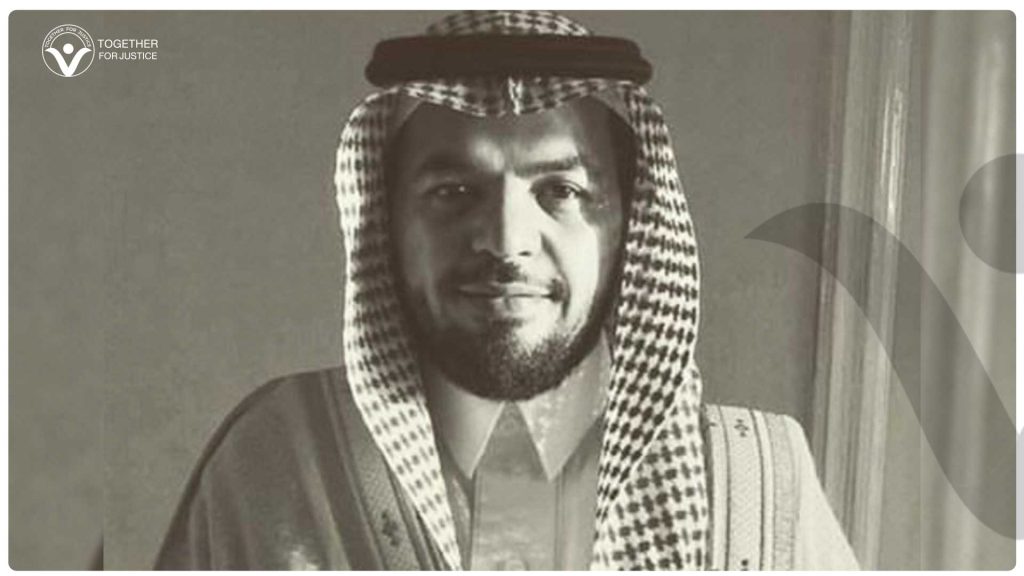
Together for Justice recalls the case of Dr. Mubarak bin Zuair, a media professor at Imam Muhammad ibn Saud Islamic University and the son of prominent scholar Saeed bin Zuair, who has been detained since 2017 as part of the wide crackdown targeting preachers, academics, rights defenders, and independent opinion-holders in Saudi Arabia.
Nine years after his arrest, Dr. Mubarak bin Zuair remains in detention without a clear and publicly announced verdict, and without a transparent legal process explaining the charges against him or the legal basis for his continued deprivation of liberty. Keeping a person behind bars for this long without a public judgment cannot be treated as a normal legal procedure. It amounts to prolonged arbitrary detention and a serious violation of fair trial guarantees.
Available information indicates that Dr. bin Zuair was subjected to a secret trial in 2018, in proceedings that lacked publicity, transparency, and basic defence guarantees. Secret trials in opinion-related cases do not deliver justice; they conceal it. They block public scrutiny, weaken the detainee’s ability to defend himself, and leave families and society without any clear knowledge of what is happening inside the courtroom.
Dr. Mubarak bin Zuair was known for peaceful reformist views and for calling for freedoms and reform inside the kingdom. He was not known for violence or incitement. His profile was academic, intellectual, and media-related. Yet he became a target of a security campaign that treats independent opinion as a threat and peaceful reform as a punishable offence.
Before his arrest, Dr. bin Zuair was removed from his academic role and separated from his students, showing that punishment began even before imprisonment. He was first deprived of his professional and social role, and later deprived of his liberty, in a process that reflects the authorities’ attempt to isolate independent voices professionally, socially, and legally.
Dr. Mubarak bin Zuair obtained a master’s degree in criticism from Imam Muhammad ibn Saud Islamic University, followed by a PhD in literature from the same university, before working as a professor of media. His academic standing, however, did not protect him from a crackdown that reached scholars and thinkers inside universities, religious institutions, and media spaces, turning places of knowledge and debate into environments where independent voices are afraid to speak.
His continued detention since 2017 without a public verdict exposes a deep crisis within Saudi Arabia’s justice system. If the authorities have genuine legal charges against him, they must disclose them clearly, allow him to defend himself, and bring him before a fair and public trial before an independent court. Keeping him in prison for years without transparency is punishment outside the rule of law.
Together for Justice stresses that Dr. Mubarak bin Zuair’s case forms part of a wider pattern of targeting academics and opinion-holders in Saudi Arabia. The authorities continue to use detention, closed trials, and information blackouts to silence those with independent intellectual influence or reformist views outside the official narrative.
The organization holds the Saudi authorities fully responsible for Dr. Mubarak bin Zuair’s physical and psychological safety. It calls for the immediate disclosure of his current health and legal status, and for his family and lawyer to be allowed to communicate with him without restriction.
Together for Justice calls for his immediate and unconditional release unless clear and lawful charges are publicly presented against him. If any charges exist, he must be brought immediately before a fair and public trial that meets all guarantees of defence, transparency, and judicial independence. Mubarak bin Zuair has not only been deprived of his liberty; he has also been deprived of public justice, while his family has been denied the right to know the truth and his students and society have been denied an independent academic voice. After nine years in detention without a public verdict, his case remains a stark example of a reality in which speech is punished, reform is imprisoned, and justice is left behind closed doors.