


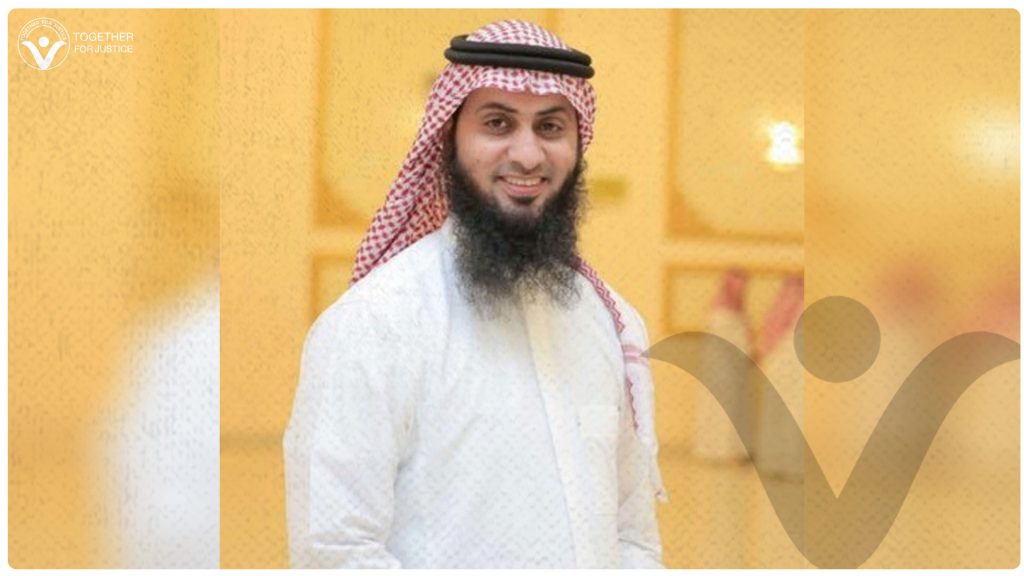
Together for Justice reminds the international community of the case of Saudi preacher and reformist figure Sheikh Naif Al-Sahafi, who has been detained since September 2017 as part of the wide crackdown that targeted scholars, academics, intellectuals, and independent voices in Saudi Arabia. That campaign marked one of the clearest phases of repression following Mohammed bin Salman’s rise to the position of Crown Prince.
Al-Sahafi is now approaching nine years behind bars, in a case that exposes how Saudi authorities have treated even moderate reformist voices as threats to be silenced. He was not known for violence or incitement, but for a religious and intellectual discourse centered on reform, advice, moderation, and independent thought.
Naif Al-Sahafi was widely known for his moderate reformist approach and for rejecting extremism and violence. Yet this did not protect him from being swept into the September 2017 arrests, which targeted prominent figures in Saudi Arabia’s independent religious and intellectual sphere. After years of detention and restricted information about his condition, the Specialized Criminal Court sentenced him in 2020 to ten years in prison.
Together for Justice stresses that the sentence against Al-Sahafi cannot be separated from the political context in which the Specialized Criminal Court has been used to prosecute preachers, thinkers, and prisoners of conscience rather than genuine criminal offenses. His trial lacked transparency and basic fair trial guarantees, with no clear public disclosure of the evidence or charges against him, and serious concerns over his ability to defend himself and access effective legal representation.
Since his sentencing, Al-Sahafi’s suffering in prison has continued. Available information indicates that he has been deprived of regular contact with his family, denied visits, and subjected to long periods of total blackout. This raises serious concerns about his physical and psychological well-being, especially in light of repeated reports of isolation, ill-treatment, medical neglect, and denial of basic rights affecting prisoners of conscience in Saudi Arabia.
The significance of Al-Sahafi’s case lies not only in the length of his detention, but in the message behind it: in Saudi Arabia, any independent discourse — even if moderate, reformist, and nonviolent — can become grounds for years of imprisonment. The authorities are not only targeting violent conduct; they are targeting voices with social influence outside state control and beyond the official narrative.
His case forms part of a broader pattern that has targeted religious and intellectual figures since 2017, including preachers, academics, and writers who were not accused of violent acts, but punished for their opinions, public presence, or intellectual independence. In this context, trials have become tools to forcibly reshape the religious and intellectual sphere and exclude every voice that does not fully align with the state’s official line.
From a legal perspective, Al-Sahafi’s arrest and conviction in a case linked to opinion and public discourse violate his rights to liberty, security of person, freedom of expression, and fair trial guarantees. The denial of regular family and legal contact, along with the prolonged interruption of information about his condition, further increases concerns about his safety and places full responsibility for his life and health on the Saudi authorities.
Together for Justice stresses that the continued imprisonment of Naif Al-Sahafi after all these years is not an act of justice. It is a long-term political punishment against an independent reformist voice. Denying him basic rights inside prison turns his sentence into a process of isolation, psychological pressure, and social erasure.
Together for Justice calls for the immediate and unconditional release of Sheikh Naif Al-Sahafi, the annulment of the unjust sentence against him, access to his family and legal counsel, and full disclosure of his current health and legal status.
The organization also calls for an independent investigation into the circumstances of his arrest, detention, and any violations he may have suffered in prison. Saudi authorities must guarantee his access to medical care and basic human rights, and must stop using the Specialized Criminal Court as a tool to punish preachers, thinkers, and independent voices.
Naif Al-Sahafi was not imprisoned because he posed a threat to society. He was imprisoned because he represented an independent reformist voice in a country where independence itself has become a charge. Nearly nine years after his arrest, his case remains a stark reminder of a reality in which calls for reform are met with prison, and free thought is treated as a danger to be locked away.