


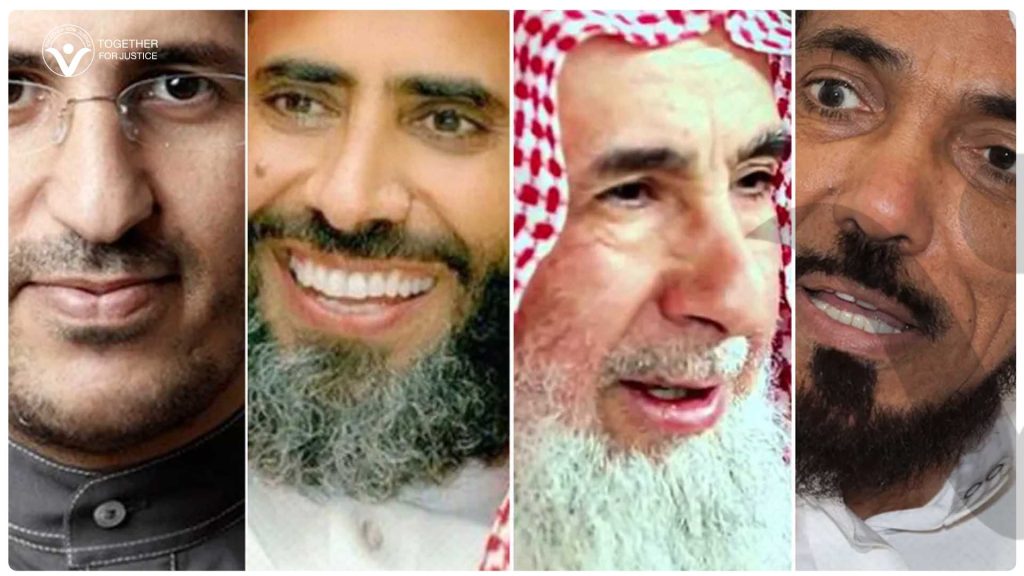
In September 2017, the Saudi authorities launched one of the most extensive campaigns of repression in the Kingdom’s recent history. The crackdown did not target an armed group or individuals accused of committing acts of violence. Instead, it swept up dozens of religious scholars, academics, intellectuals, economists, journalists and writers for expressing independent opinions, advocating reform or refusing to offer unconditional public support for official policies.
This September marks the ninth anniversary of that crackdown. Yet several of its most prominent victims remain behind bars. Some continue to be held without a publicly confirmed final verdict, while others are serving lengthy prison sentences or facing demands for the death penalty over tweets, private messages and peaceful religious, political or economic opinions.
A legal opinion submitted through the United Nations Universal Periodic Review process examined the arrests and detention of more than 60 people and concluded that the September 2017 crackdown was arbitrary. Amnesty International described it as an assault on the last vestiges of freedom of expression in Saudi Arabia, while Human Rights Watch identified the arrests as the beginning of a series of campaigns targeting critics and potential critics of government policies. United Nations submission, Amnesty International, Human Rights Watch
A crackdown that criminalised silence as well as speech
The arrests began less than three months after Mohammed bin Salman became Crown Prince and at the height of the Gulf crisis and blockade of Qatar.
At the time, prominent public figures were not merely expected to refrain from criticising the government. They were also expected to publicly endorse its position. Those who refused to participate in the hostile media campaign, maintained an independent opinion or called for reconciliation risked being treated as suspects.
Saudi authorities alleged that the detainees had links to “foreign entities” or posed a threat to national security. Yet they presented no public evidence showing that the detained scholars, writers and academics had committed violent crimes. Available court documents and reports about their trials instead show that many of the accusations concerned tweets, WhatsApp messages, media appearances, intellectual writings, peaceful associations and contact with journalists or international organisations.
Saudi Arabia’s counterterrorism and cybercrime laws, together with the Specialised Criminal Court originally established to hear terrorism cases, consequently became instruments for criminalising peaceful expression and intellectual independence.
Salman al-Odah: A prayer for reconciliation answered with prison
Dr Salman al-Odah is perhaps the most prominent victim of the September crackdown. Saudi authorities arrested him on 9 September 2017 after he posted a tweet praying for a “softening of hearts” following reports of a possible reconciliation between Saudi Arabia and Qatar.
The tweet contained neither criticism of the authorities nor incitement to violence. Nevertheless, al-Odah was arrested without a warrant, and his whereabouts were concealed from his family for months.
Human rights reports indicate that he has endured prolonged solitary confinement, restricted family contact and inadequate medical care. His health has deteriorated significantly, with his family reporting that he has suffered partial loss of hearing and sight as a consequence of his detention conditions.
His trial before the Specialised Criminal Court began in September 2018. The Public Prosecution brought dozens of charges against him and sought the death penalty. The case was based not on any violent act, but on his intellectual positions, relationships, writings and social media activity, including his response to the Gulf crisis and earlier calls for political reform.
His trial has reportedly remained suspended since July 2021, leaving him trapped between indefinite detention and the threat of execution. Nine years later, one of Saudi Arabia’s best-known religious scholars remains imprisoned because his voice did not conform to the official narrative. ALQST for Human Rights, US Commission on International Religious Freedom
Awad al-Qarni: Social media accounts treated as criminal evidence
Dr Awad al-Qarni, a former university professor, author and prominent religious scholar, was arrested in September 2017. He was known for supporting reform and criticising earlier campaigns of arbitrary arrests and travel bans against Saudi intellectuals.
Court documents revealed that prosecutors treated his possession of an account on X, formerly Twitter, his reposting of material and his use of WhatsApp and Telegram as evidence against him. The prosecution sought the death penalty even though the published allegations related primarily to peaceful expression and online activity rather than violence.
In 2023, the UN Working Group on Arbitrary Detention concluded that al-Qarni’s deprivation of liberty was arbitrary and contrary to international human rights law. It called for his immediate release and for him to receive compensation and other appropriate reparations.
Saudi authorities have nevertheless continued to detain him, while the threat of an exceptionally harsh sentence remains over his case. His prosecution provides a disturbing example of how the most ordinary means of modern communication can be transformed into evidence of terrorism when the user expresses opinions the authorities consider unacceptable. UN findings on al-Qarni’s detention, MENA Rights Group
Ali al-Omari: A media figure facing death over peaceful activity
Armed security officers arrested Dr Ali al-Omari during a raid on his home on 9 September 2017. Al-Omari is a religious scholar and media figure who founded the youth-oriented television channel 4Shbab and presented programmes addressing religious, social and youth issues.
He was reportedly charged with more than 30 offences, including “forming a youth organisation to carry out terrorist acts”, although his publicly known work focused on media, education and youth engagement. The prosecution sought the death penalty amid profound secrecy surrounding his trial and legal status.
Human rights organisations have reported that al-Omari was subjected to serious violations in detention, including solitary confinement, ill-treatment and denial of basic fair-trial guarantees. The Saudi authorities have not provided a transparent public account of the final outcome of his trial, while unconfirmed reports have suggested that he may have been sentenced to death.
Keeping a detainee and his family under the threat of execution for years without transparent proceedings or a publicly confirmed judgment is not a legitimate judicial process. It is a form of prolonged psychological cruelty and arbitrary punishment. ALQST for Human Rights, Committee to Protect Journalists
Hassan Farhan al-Maliki: Intellectual disagreement punishable by death
Saudi security forces arrested Islamic thinker and researcher Hassan Farhan al-Maliki at his home on 11 September 2017 without presenting a warrant.
Al-Maliki is known for his critical examination of religious heritage, his rejection of sectarianism and his calls to reconsider traditional interpretations that contribute to intolerance and hatred. Instead of protecting his right to research and express his views, the Saudi authorities turned his religious and intellectual positions into a national security case.
The charges against him reportedly included his books, interviews, tweets and participation in public debates. The prosecution sought the death penalty.
His case demonstrates that the September crackdown was not directed at one ideological current. It targeted scholars, reformists and intellectuals holding widely different views. What united them was not membership in a single political movement, but their refusal to surrender every measure of intellectual independence to the state.
Seeking the execution of a researcher for his writings and interpretations constitutes an extreme violation of freedom of thought, conscience and expression. It also sends a message of intimidation to every academic or intellectual who might consider challenging an officially approved narrative. MENA Rights Group
Essam al-Zamel: When economic analysis became a crime
Essam al-Zamel was a respected businessman and economist known for his detailed public analysis of Saudi economic policy. He had participated in a Saudi delegation to an economic conference in the United States, but was arrested on his return to the Kingdom on 12 September 2017.
Before his detention, al-Zamel had published analyses questioning the announced valuation of Saudi Aramco and the plan to sell part of the state oil company through an initial public offering. He warned of the economic risks and challenged some of the figures used to promote the project.
He carried no weapon and advocated no violence. His tools were economic data and analysis.
Saudi authorities accused him of offences that included seeking to stir up sedition through X, communicating with foreign parties and alleged membership in a banned organisation. In October 2020, the Specialised Criminal Court sentenced him to 15 years in prison following proceedings that human rights organisations described as lacking fairness and transparency.
Al-Zamel’s case shows that the crackdown was not confined to religious scholars. It extended to specialists with the knowledge and credibility to scrutinise official economic policies. In a country promoting an ambitious economic transformation, an economist was imprisoned for performing the essential function of his profession: examining the figures and asking difficult questions. ALQST for Human Rights, Committee to Protect Journalists
Mohammed Musa al-Sharif: A scholar and historian turned prisoner of conscience
Dr Mohammed Musa al-Sharif was arrested in September 2017 as part of the same crackdown. A former airline pilot and university professor, he is also a historian and author of numerous books and lectures on history, Islamic biography, education and religious thought.
For a prolonged period, al-Sharif was denied transparent proceedings that met international fair-trial standards. Reports from court sessions described him as visibly exhausted and unwell, raising recurring concerns about his health and conditions of detention.
He was prosecuted before the Specialised Criminal Court in secret proceedings, and human rights reports subsequently indicated that his prison sentence was increased on appeal. The secrecy surrounding the case has produced conflicting reports about the precise length of his sentence. What remains clear is that he has spent nine years in prison because of his peaceful intellectual and religious activity, rather than any violent offence established in a transparent and fair trial.
The lack of reliable official information is itself part of the violation. Secret trials and the withholding of basic details from families and the public leave detainees at the mercy of proceedings that escape meaningful scrutiny.
Mubarak bin Zuair: Nine years without a clear public judgment
Dr Mubarak bin Zuair, a professor of media at Imam Mohammad Ibn Saud Islamic University, represents another dimension of the injustice. He was detained during the wider crackdown that began in September 2017 and has remained behind bars for nine years without a clear and publicly announced judgment.
Available information indicates that he was subjected to secret proceedings beginning in 2018. Neither the public nor independent human rights organisations were given meaningful access to the charges, evidence or progress of his case. The UN Working Group on Arbitrary Detention has previously examined his case and found that his detention lacked a legal basis.
Holding a university professor for nearly a decade without a transparent verdict cannot be justified by the requirements of justice or national security. It is open-ended imprisonment that destroys the presumption of innocence and turns the absence of a judgment into a punishment harsher than the judgment itself. Alkarama’s documentation of his case
Reform on the surface, repression at the core
Over the past nine years, the Saudi authorities have invested enormous resources in presenting the Kingdom as a transformed country. Entertainment festivals, international sporting events, cultural projects and multibillion-dollar developments have all been used to promote an image of modernisation and openness.
Genuine openness, however, is not measured by the number of events a country hosts, the celebrities it attracts or the scale of its public-relations campaigns. It is measured by whether people can express an opinion without fearing arrest, disappearance, torture or prosecution before a terrorism court.
There can be no credible claim of reform while reformers, thinkers and academics remain behind bars. An economic transformation cannot be celebrated while an economist is imprisoned for questioning an economic valuation. Nor can official rhetoric about moderation be taken seriously while scholars face execution over books, tweets and private messages.
The September detainees dreamed of a fairer and freer homeland—one in which citizens could advise, criticise and disagree without fearing a raid on their homes or years of disappearance and imprisonment. Instead, they have spent nine years beneath the hammer of repression and on the anvil of persecution, while their freedom has been sacrificed to maintain a carefully constructed international image.
The September arrests were not an isolated event that ended with the close of that month. They announced a new political formula: citizens may be granted entertainment, but not meaningful participation; they may consume, but not object; and they may celebrate official decisions, but never hold their authors accountable.
Together for Justice’s demands
On the ninth anniversary of the September crackdown, Together for Justice stresses that the continued imprisonment of peaceful critics cannot be erased by the passage of time. Economic and social modernisation cannot substitute for respect for fundamental rights and freedoms.
Together for Justice calls on the Saudi authorities to:
- Immediately and unconditionally release everyone detained solely for peacefully exercising their rights to freedom of expression, thought, conscience and religion.
- Withdraw all demands for the death penalty and quash sentences based on tweets, writings, private communications and other peaceful activities.
- Disclose the location, legal status and detention conditions of every person arrested during the September crackdown.
- Establish an independent investigation into allegations of torture, prolonged solitary confinement, enforced disappearance, denial of medical care and restrictions on access to families and lawyers.
- Grant new trials before independent civilian courts to anyone convicted through secret or fundamentally unfair proceedings.
- Provide victims with adequate compensation for arbitrary detention and restore their rights and reputations.
After nine years, the Saudi authorities can no longer portray these detentions as temporary measures required for investigation. Time itself has become evidence of the injustice.
Every anniversary the detainees spend behind bars is a further reminder that the reform Saudi Arabia promotes abroad has yet to reach the place where it is most urgently needed: the doors of its prisons.