


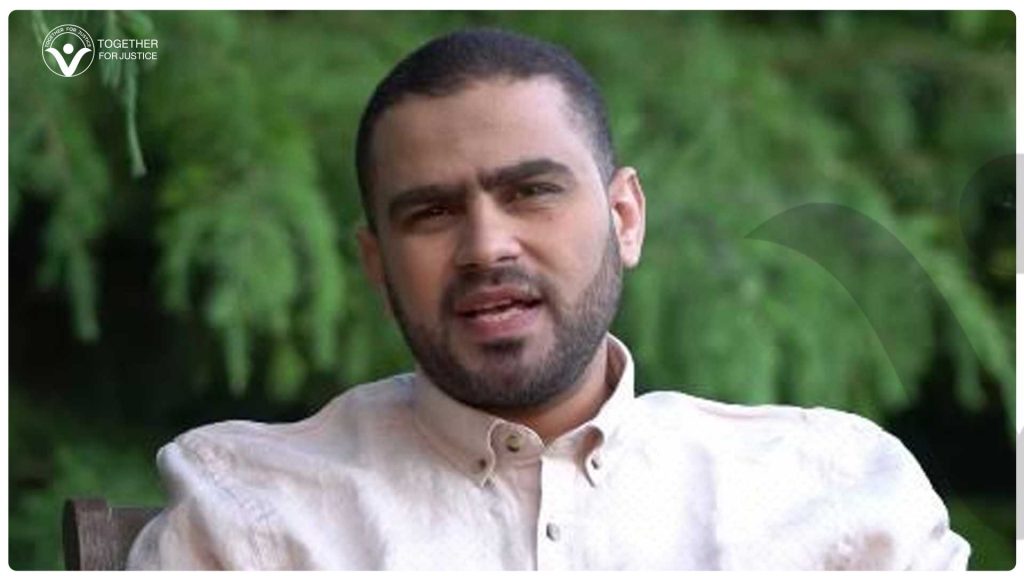
Together for Justice condemns the continued detention of Saudi academic and Qur’an memorizer Dr. Osama Al-Hasani, who was extradited from Morocco to Saudi Arabia in March 2021, later tried before the Specialized Criminal Court, and sentenced to four years in prison. Despite the expiry of that sentence, he remains disappeared in Saudi prisons.
The case dates back to February 2021, when Al-Hasani was arrested in Tangier, Morocco, on the basis of an Interpol Red Notice issued at Saudi Arabia’s request. On 12 March 2021, the UN Committee against Torture asked Morocco not to extradite him while his case was under review. The following day, Moroccan authorities extradited him to Saudi Arabia at 2:45 a.m., before the Committee’s request was considered by the relevant Moroccan authorities.
Al-Hasani’s extradition raised serious concerns under the principle of non-refoulement, which prohibits transferring a person to a state where they face a real risk of torture, ill-treatment, or unfair trial. Those concerns were especially serious given Saudi Arabia’s record of abusive detention practices and the use of exceptional courts in politically sensitive cases.
According to available information, a malicious or retaliatory claim was used as a gateway to secure Al-Hasani’s transfer to Saudi Arabia, after which the case moved into a far more serious security and judicial track. The UN Committee against Torture noted information indicating that the Saudi Specialized Criminal Court sentenced Al-Hasani to four years in prison, while recalling previous concerns that this court lacked sufficient independence and had ignored allegations of ill-treatment during interrogations.
Together for Justice stresses that the danger of Al-Hasani’s case lies not only in his extradition or the sentence issued against him, but in the fact that he remains detained despite the completion of that sentence. Holding a person after the expiry of their prison term amounts to a new act of arbitrary detention, without clear legal basis, and shows that the case is being handled not as a matter of justice, but as open-ended punishment.
Rights information indicates that Al-Hasani was subjected to torture and pressure after his transfer to Saudi Arabia in order to extract confessions. Any judicial process built on statements obtained under coercion is legally and morally invalid. A fair trial cannot be based on disappearance, torture, denial of defence rights, or proceedings before an exceptional court in a case carrying political or retaliatory features.
Dr. Osama Al-Hasani, an academic, Qur’an memorizer, and Australian citizen, is not an isolated case. His ordeal reflects a broader pattern in which Saudi authorities have used extradition requests, Interpol mechanisms, third-country transfers, opaque trials, and exceptional courts to bring independent or targeted individuals back under Saudi control and subject them to proceedings lacking basic guarantees.
His continued disappearance after the expiry of his sentence is a direct test of any claim to rule of law. If his sentence has ended, there is no lawful justification for keeping him in prison or preventing him from reuniting with his family. If the authorities claim there is a new legal basis for his detention, they must disclose it publicly and allow him full defence rights before an independent and public court.
Together for Justice holds the Saudi authorities fully responsible for Dr. Osama Al-Hasani’s physical and psychological safety. The organization calls for the immediate disclosure of his place of detention, health condition, and legal status, and for his family and lawyer to be allowed to communicate with him without restriction.
Together for Justice further calls for his immediate and unconditional release, compensation for the period of detention following the completion of his sentence, and an independent investigation into allegations of torture, coercion, and forced confessions, with accountability for all those responsible or complicit.
The organization also calls on the Australian government to act seriously to protect one of its citizens, publicly press Saudi authorities for his release, and ensure his safe return to his family. It further urges the international community to scrutinize extradition and Interpol requests in cases that may conceal political or retaliatory motives.
Osama Al-Hasani’s case exposes a dangerous chain of violations: a malicious claim, forced extradition, alleged torture to extract confessions, trial before an exceptional court, and continued detention after the sentence ended. This is not justice. It is a continuing abuse that must end with his immediate release and full rehabilitation.