


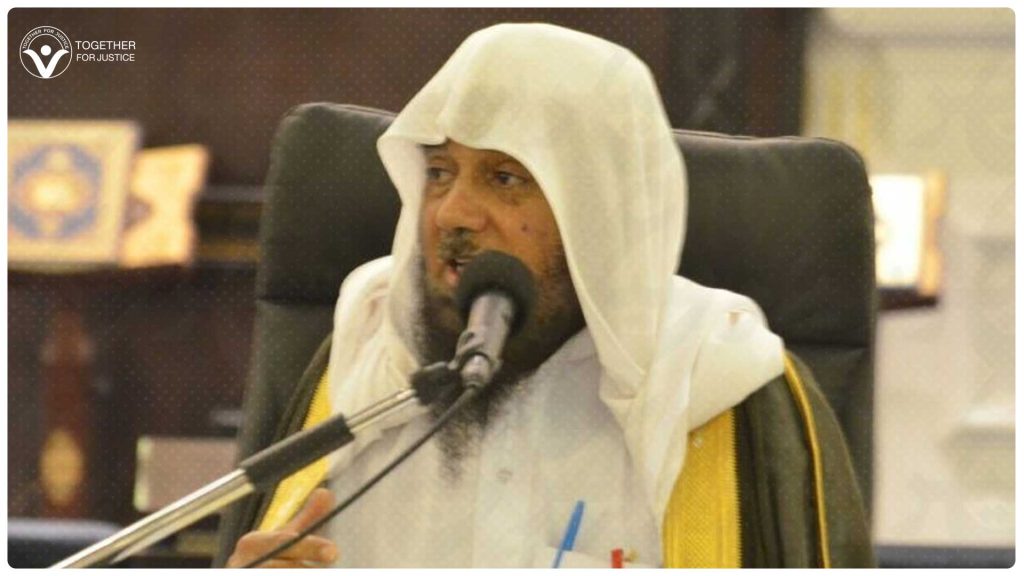
Together for Justice reminds the international community of the case of Sheikh Dr. Rashid bin Hassan Al-Almaei, a professor at the College of Fundamentals of Religion at King Khalid University in Abha, who has been detained since July 2021 and sentenced to nine years in prison, followed by a nine-year travel ban. His case reflects the continued targeting of academics, scholars, and independent voices in Saudi Arabia through vague charges that do not correspond to any recognizable criminal act.
The seriousness of his case has deepened amid reports that violations during his detention have led to a severe deterioration in his health and mental condition, including near-total memory loss. This places full responsibility on the Saudi authorities for his safety, life, medical care, and human dignity.
Dr. Al-Almaei was arrested on 8 July 2021 over matters dating back several years, including his participation in a licensed seminar held in 2013 under the title “Freedom Between Slogan and Reality” at the home of Dr. Awad Al-Qarni. He was also targeted over possession of a religious book titled From the Guidance of Islam: Contemporary Fatwas, a known jurisprudential work that contains no incitement or illegal content.
During the course of his trial, his participation in an old intellectual seminar and possession of a religious book were treated as grounds for criminalization. This reveals the nature of politically driven trials in Saudi Arabia, where the objective is not to establish a genuine crime, but to find a pretext to punish independent thought. Instead of protecting academic dialogue, religious scholarship, and intellectual discussion, the authorities turned them into a security file that ended with a harsh prison sentence and travel ban.
Al-Almaei’s case shows how Saudi authorities treat intellectual and religious spaces as areas to be tightly controlled. A university professor who takes part in a public discussion or owns a religious book should not find himself imprisoned, nor should thought, reading, or dialogue be framed as threats to public security.
Together for Justice stresses that the nine-year sentence against him is not an act of justice, but a political punishment against an academic who was not accused of violence or incitement. The additional nine-year travel ban imposed after his sentence further extends the punishment beyond prison and seeks to isolate him even after his release.
The reported violations inside detention make the case even more alarming. Near-total memory loss cannot be treated as a minor health issue. It is a serious warning about his detention conditions, possible medical neglect, ill-treatment, and denial of adequate care. Any deterioration of this severity inside prison creates direct legal responsibility for the detaining state, particularly if urgent and independent medical intervention is not provided.
From a legal perspective, his arrest and conviction over an old intellectual event and possession of a book, followed by detention conditions that reportedly caused severe cognitive deterioration, constitute multiple violations: freedom of opinion and expression, the right to a fair trial, the right to health, and protection from cruel, inhuman, or degrading treatment.
Al-Almaei’s case forms part of a wider pattern of targeting scholars, preachers, and academics in Saudi Arabia. Trials have become tools to reshape the religious and intellectual sphere according to the official line, while excluding independent voices. In this context, individuals are not only punished for what they say, but sometimes for where they were present, what they read, who they knew, or intellectual activities that took place years earlier.
Together for Justice holds the Saudi authorities fully responsible for the physical and psychological safety of Sheikh Dr. Rashid bin Hassan Al-Almaei. The organization calls for the immediate disclosure of his current health condition, access to an independent medical examination, urgent medical care, and regular communication with his family and legal counsel.
Together for Justice further calls for his immediate and unconditional release, the annulment of the unjust sentence against him, and an independent investigation into the violations he suffered in detention, including the reported abuse or medical neglect that led to his near-total memory loss. Those responsible for any ill-treatment or denial of medical care must be held accountable.
The continued imprisonment of Rashid Al-Almaei proves that Saudi authorities still treat thought as a threat, academics as potential enemies, and dialogue as a crime. The reported collapse of his memory is a reminder that punishment in cases of opinion does not end with a prison sentence; it can extend to the body, the mind, and the very dignity of the person.