Bahrain’s Award to UK Ambassador Exposes a Wider Machinery of Whitewashing, Influence-Buying, and Western Complicity
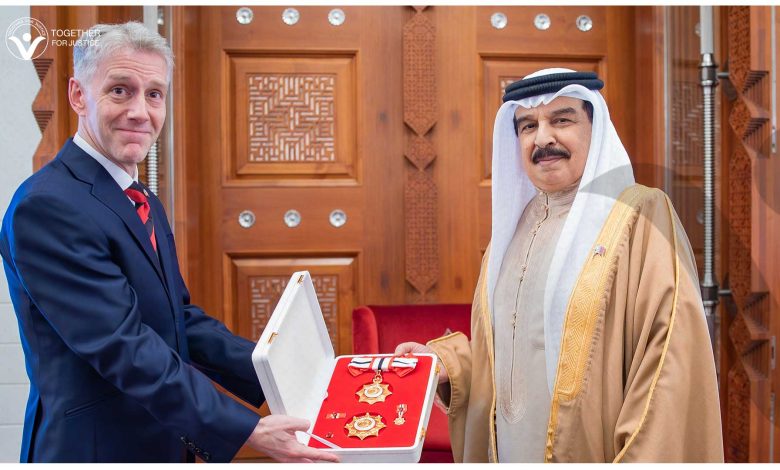
The presentation of Bahrain’s Order of Bahrain to the British ambassador in Manama, Alastair Long, has reignited serious questions about the relationship between the Bahraini regime and Western powers, and about the role of British diplomacy in granting political and moral cover to a dictatorship that continues to repress its people, silence dissent, and evade accountability for grave human rights violations.
Together for Justice states that this incident must not be treated as a mere ceremonial gesture or diplomatic courtesy. It is part of a broader and deliberate policy pursued by the Bahraini authorities to launder their image internationally, buy influence within Western political and diplomatic circles, and convert relations with foreign officials into symbols of legitimacy that obscure the reality of repression, torture, arbitrary detention, citizenship revocation, and the systematic closure of political space.
The Bahraini regime presents itself abroad as a stable, reform-minded and reliable partner. At home, however, it maintains a deeply repressive security state in which independent voices are punished, political opposition is dismantled, human rights defenders are targeted, clerics and activists are persecuted, and state institutions are used to enforce obedience rather than protect rights. The contrast between Bahrain’s polished diplomatic image and its domestic reality is not accidental; it is the essence of the regime’s whitewashing strategy.
The significance of the award lies not in the medal itself, but in its political function. Authoritarian regimes do not always seek to deny their abuses; often, they seek to bury them under layers of public relations, ceremonial honours, diplomatic receptions, security partnerships, and carefully staged images of international acceptance. In this context, an award becomes more than a symbolic object. It becomes a tool of political laundering. It allows a repressive regime to send a message to its own population and to the wider world: that it remains accepted, protected, and integrated into the network of Western interests.
Together for Justice stresses that Bahrain has long relied on such tools to manufacture an image of reform and moderation while continuing to suppress fundamental freedoms. The state that honours foreign diplomats is the same state accused of arbitrary arrests, targeting human rights defenders, stripping citizens of their nationality, persecuting Shia clerics and activists, and suffocating any meaningful form of independent political life.
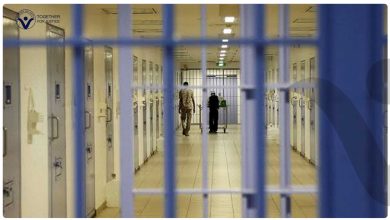
This incident comes against the backdrop of continuing concern over the death of 32-year-old Sayed Mohamed Almosawi in custody after his enforced disappearance, amid reports that his body bore signs of torture. A regime facing such serious allegations should not be rewarded with diplomatic normalisation, ceremonial legitimacy, or the appearance of Western approval. No official image, award ceremony, or diplomatic tribute should be allowed to cover the violence taking place behind prison walls.
The problem does not stop in Manama. It extends to the Western capitals that continue to treat the Bahraini regime as a normal partner despite full awareness of its record. Britain, in particular, bears a special political and moral responsibility. It does not merely remain silent about Bahrain’s abuses; through its diplomatic posture, security cooperation, and tolerance of repeated acts of regime whitewashing, it helps provide Bahrain with the external legitimacy it seeks.
The acceptance or normalisation of such honours sends a devastating message to victims, prisoners, exiles, and families of those tortured or persecuted by the Bahraini authorities. It tells them that strategic interests matter more than justice; that security cooperation and commercial relationships can swallow every public claim about democracy, accountability, and the rule of law; and that dictatorships allied with Western powers can continue their abuses while still being welcomed, decorated, and protected.
Together for Justice considers this not simply silence, but practical complicity. The Bahraini regime has learned how to buy influence, reward compliance, and transform official relationships into instruments of political whitewashing. When current or former Western officials, diplomats, ministers, and advisers become part of a network that grants legitimacy to an abusive regime, Western rhetoric about human rights becomes hollow and deeply selective.
Bahrain has mastered the language of Western diplomacy. It speaks of stability to justify repression, of reform to conceal the absence of democracy, of partnership to mask systematic abuses, and of coexistence to distract from discrimination, political exclusion, and the targeting of dissenting communities. In return, major powers continue to give the regime what it needs most: silence, official photographs, security cooperation, diplomatic warmth, and international normalisation.
The incident also exposes a deeper failure in Britain’s policy toward Bahrain. A government that claims to uphold human rights cannot dismiss the honouring of its diplomats by a repressive ruler as a minor matter of protocol. Nor can it ignore a recurring pattern in which the Bahraini authorities use honours, institutions, advisory roles, and diplomatic networks to penetrate British political life and manufacture legitimacy abroad.
Together for Justice calls on the British government to conduct a transparent review of the circumstances surrounding the award granted to Ambassador Alastair Long, including whether it complied with Foreign, Commonwealth and Development Office rules on the acceptance of foreign honours, and whether the Bahraini authorities followed the required procedures before presenting it. The government must also examine the wider relationship between British officials, former ministers, diplomats, and Bahraini state-linked institutions that have been used to soften or launder the regime’s image.
The organisation further calls on Britain, the United States, and the European Union to end their policy of indulgence toward the Bahraini regime. Any political, security, or economic cooperation with Bahrain must be tied to measurable human rights conditions, including the release of political prisoners, an end to reprisals against activists and clerics, the reversal of arbitrary citizenship revocations, independent investigations into torture and deaths in custody, and guarantees for freedom of expression, association, and peaceful political activity.
Bahrain does not need more photographs with Western diplomats. It needs accountability. Victims do not need carefully worded statements of “concern”; they need clear political consequences for repression, torture, and the destruction of civic life.
Together for Justice affirms that medals do not erase torture, official ceremonies do not wash away dictatorship, and diplomatic partnerships do not grant legitimacy to a regime that continues to crush its own people. As long as major powers protect authoritarian allies from accountability, they remain politically and morally complicit in the machinery of repression they claim to oppose.