
Mohammed Al-Hudhaif: Why Does Saudi Arabia Still Imprison a Man for Warning of Emirati Interference It Now Acknowledges?
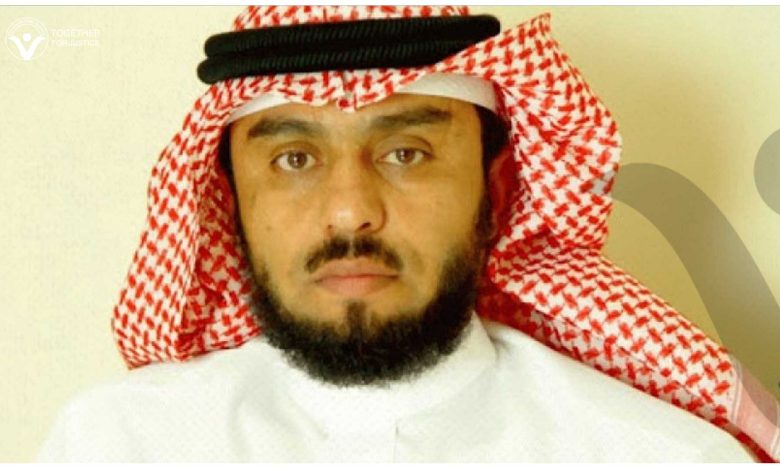
Nearly ten years after his arrest, Saudi academic and writer Mohammed Al‑Hudhaif remains in prison for expressing a view that Saudi authorities themselves now publicly advance: that Emirati interference poses a serious threat to Saudi sovereignty and national security. The contradiction is stark. While Riyadh today frames its dispute with Abu Dhabi in the language of sovereignty and national defense, it continues to imprison one of the earliest Saudi voices who raised precisely these concerns.
Al-Hudhaif was arrested on 19 March 2016 at Riyadh airport upon his return from Turkey. His detention followed a tweet questioning the legitimacy of Emirati involvement in Saudi internal affairs and its role in campaigns targeting Saudi civil society organisations. He did not advocate violence, call for unrest, or incite hostility. His remarks fell squarely within the bounds of peaceful political expression. Nonetheless, Saudi authorities treated his criticism as a criminal act, charging him under broadly defined offences including “insulting a friendly state”.
From the outset, Al-Hudhaif was denied fundamental legal protections. He was not permitted to appoint legal counsel and was tried in closed proceedings that failed to meet basic fair-trial standards. What followed was not a transparent judicial process, but a sequence of escalating punishments. Initially sentenced to five years in prison and a travel ban, his sentence was later increased to nine years and, in early 2023, extended to 13 years. The progressive lengthening of his sentence underscores the punitive nature of the case rather than any legitimate legal rationale.
The case cannot be understood in isolation from the broader Saudi-Emirati political relationship. Credible accounts indicate that Al-Hudhaif’s arrest followed a direct complaint from Abu Dhabi and was accompanied by a coordinated online campaign aimed at discrediting him and inciting public hostility. This pattern suggests a troubling degree of political alignment in suppressing dissenting voices and raises serious questions about the independence of Saudi decision-making when domestic criticism intersects with regional alliances.
Al-Hudhaif is not a marginal commentator. He is an established academic with a significant professional record. He earned his undergraduate degree with honours from King Saud University, completed a master’s degree in media theory at the University of Kansas, and obtained his doctorate from the University of Wales. In 1993, he co-founded the Committee for the Defence of Legitimate Rights and later contributed to numerous academic and media projects. Criminalising such a figure for expressing a political opinion reflects a system that penalises ideas rather than actions.
Today, as Saudi officials publicly warn of Emirati interference and frame it as a threat to national sovereignty, a central question remains unanswered: why does the man who articulated these concerns years earlier remain in prison? Why is the same analysis now accepted at the state level, while the individual who voiced it first continues to serve a lengthy sentence? The answer appears less about the substance of Al-Hudhaif’s views than about timing and control.
Al-Hudhaif’s continued detention represents a clear violation of the right to freedom of expression and exposes a deeper contradiction in Saudi Arabia’s sovereignty discourse. A state cannot credibly claim to defend its sovereignty while imprisoning citizens for raising legitimate concerns about its erosion. Nor can national security be strengthened by silencing those who warned of external influence long before it became politically convenient to do so.
The immediate and unconditional release of Mohammed Al-Hudhaif is therefore not only a human rights necessity, but a test of political credibility. Accountability for the violations surrounding his arrest, trial, and sentencing remains essential. International mechanisms, including the UN Special Rapporteur on the promotion and protection of the right to freedom of opinion and expression, should treat this case as emblematic of the broader repression of peaceful political dissent in Saudi Arabia — particularly when that dissent later proves to be accurate.