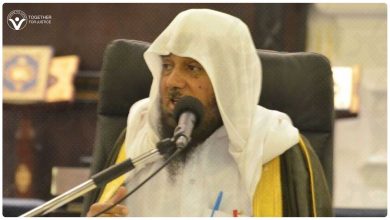
3,226 Days in Solitary Confinement: Awad Al-Qarni Faces Execution Over Tweets While Held in a Cell Smaller Than Two Meters

Together for Justice condemns the continued detention of Sheikh Dr. Awad Al-Qarni, the 69-year-old Saudi academic and preacher who has been imprisoned since the September 2017 crackdown, following new information revealed by his son that Al-Qarni has spent the entirety of his detention — now reaching 3,226 days — in solitary confinement inside a cell measuring less than two meters by two meters, while being denied even the right to attend Friday prayers in the prison mosque. At the same time, the Saudi Public Prosecution continues to seek the death penalty against him over tweets and peaceful digital activity.
This revelation is not a minor detail in an already known case. It exposes a level of systematic abuse that is both deliberate and deeply alarming. Holding an elderly man for nearly nine years in total solitary confinement, inside an extremely narrow cell, while depriving him of normal human contact and collective religious practice, amounts to cruel and inhuman treatment and may constitute psychological and physical torture under international law.
Sheikh Awad Al-Qarni was arrested in September 2017 as part of a sweeping campaign targeting scholars, preachers, academics, intellectuals, and independent voices in Saudi Arabia. That campaign became one of the clearest markers of the new phase of repression that followed Mohammed bin Salman’s rise to the position of Crown Prince. Since then, Al-Qarni’s case has never been a genuine criminal case. It has been, from the beginning, a case of opinion and peaceful expression.
The core of the accusations against him relates to his use of social media and digital communication tools: a Twitter account under his real name, communication through WhatsApp and Telegram, and the sharing of views, ideas, and videos related to public, political, and religious matters. In any state that respects the rule of law, such conduct falls squarely within the right to freedom of expression. In Saudi Arabia, however, it has been framed as a grave security threat, with prosecutors seeking his execution.
The demand for the death penalty against a man over tweets and peaceful opinions reveals the collapse of any meaningful concept of justice in Saudi Arabia. When words become grounds for execution, and when social media use is transformed into a national security case, the judiciary ceases to function as a guardian of justice and becomes an arm of political repression.
Together for Justice stresses that the prolonged solitary confinement imposed on Sheikh Awad Al-Qarni constitutes a flagrant violation of the UN Standard Minimum Rules for the Treatment of Prisoners, known as the Mandela Rules, which regard prolonged solitary confinement as a form of cruel, inhuman, or degrading treatment. What Al-Qarni has endured goes far beyond prolonged isolation: it has lasted thousands of days, turning detention into a slow assault on the body, mind, memory, and dignity.
The risk is even more severe because Al-Qarni is now 69 years old. Holding an elderly detainee for years in such a small and isolated cell places his health and life in direct danger. Saudi authorities bear full responsibility for any physical or psychological deterioration resulting from deprivation of movement, sunlight, human contact, medical care, religious practice, and basic humane conditions.
The denial of Friday prayers, even inside the prison mosque, further demonstrates that the punishment imposed on Al-Qarni extends beyond deprivation of liberty. It reaches into his right to collective religious practice, a basic right that should not be arbitrarily denied, especially without clear, lawful, and necessary justification.
Family statements and human rights reports have also raised serious concerns about coercion, pressure, and the absence of fair trial guarantees in his case, including fears that statements may have been extracted under harsh conditions. In such circumstances, any judicial process or penalty built on opaque proceedings, coercion, or lack of independence is stripped of both legal and moral legitimacy — especially when prosecutors are seeking an irreversible punishment such as execution.
Al-Qarni’s case is not isolated. It forms part of a broader pattern in Saudi Arabia, where the digital sphere has become a trap for prisoners of conscience. Individuals have been arrested and prosecuted over tweets, retweets, opinions, online communication, or peaceful digital activity, with some receiving extremely harsh sentences. In this context, the internet is not treated as a space for expression, but as an archive of accusations used to punish those who depart from the official narrative.
Together for Justice warns that the continued demand for Al-Qarni’s execution represents a dangerous escalation against freedom of opinion and expression. This is no longer only a case of arbitrary detention; it is a threat of judicial killing over peaceful speech.
From a legal perspective, the violations in Al-Qarni’s case are multiple and grave: arbitrary detention, prolonged solitary confinement, denial of basic religious and human rights, violation of fair trial guarantees, and the threat of execution for exercising the right to peaceful expression. The continuation of such treatment against an elderly man in a cell of this size places the Saudi authorities in direct violation of international standards prohibiting torture and ill-treatment.
Together for Justice holds the Saudi authorities fully responsible for the life, physical safety, and psychological well-being of Sheikh Dr. Awad Al-Qarni. The organization calls for an immediate end to any demand for his execution and for all charges linked to his tweets, opinions, and peaceful digital activity to be dropped.
The organization further calls for his immediate and unconditional release, an immediate end to his solitary confinement, regular access to his family and legal counsel, independent medical care, and respect for his right to religious practice without retaliation or arbitrary restriction.
Together for Justice also urges the United Nations and its relevant Special Rapporteurs on torture, extrajudicial executions, freedom of opinion and expression, and arbitrary detention to intervene urgently in his case, pressure Saudi authorities to stop using the death penalty against prisoners of conscience, and open an independent investigation into the conditions of his detention and the years of solitary confinement imposed on him.
Awad Al-Qarni did not carry a weapon. He did not call for violence. He did not commit a crime that could justify imprisonment, let alone execution. He wrote, communicated, and expressed opinions. After 3,226 days in a narrow solitary cell, the real question is not what Awad Al-Qarni did, but what kind of state fears an elderly man’s tweets so deeply that it seeks to kill him for them.