As Riyadh Comes Under Attack and Casualties Mount, Turki Al-Sheikh Is Busy Reassuring the Boxing World
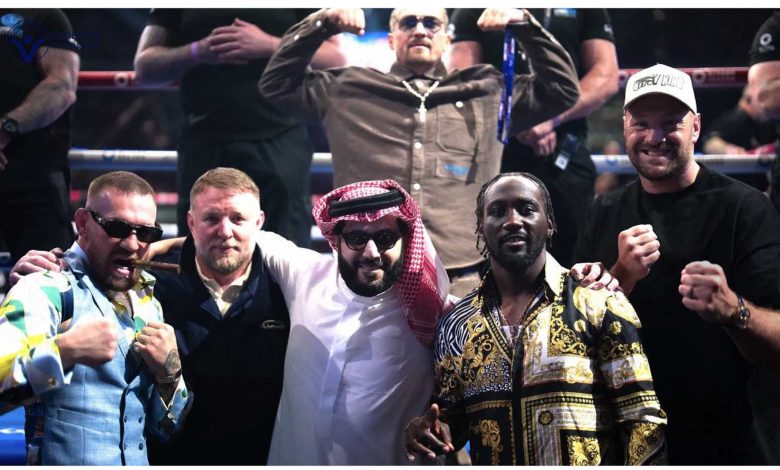
As Saudi Arabia was absorbing the shock of deadly attacks on King Khalid International Airport in Riyadh—attacks that killed civilians, injured hundreds, and threatened the safety of passengers and civil aviation—General Entertainment Authority chairman Turki Al-Sheikh chose to highlight what he apparently considered reassuring news: Mexican boxer Canelo Álvarez would not withdraw from his scheduled fight in Riyadh and “fears nothing.”
The problem is not simply that a sporting event may continue or that the country is attempting to maintain normal life during a crisis. It lies in the language Al-Sheikh used and the priorities his statement exposed. At a moment when the first words should have been directed toward the victims, their families, the injured, and the airport workers and passengers caught in the attacks, the tragedy was turned into an opportunity to celebrate a foreign boxer’s loyalty to Riyadh Season and portray his participation as proof of courage and friendship.
Blood at the airport, talk of the boxing ring
The 10 October attack on Riyadh’s international airport killed at least 12 people and injured more than 300, including Saudi citizens and residents of several nationalities. The airport was attacked again the following day, causing an additional death and further injuries as flights were disrupted, travel warnings were issued, and several international airlines suspended services.
Earlier in the same week, airport facilities and a Saudi commercial aircraft had also been attacked. Saudi Arabia’s General Authority of Civil Aviation acknowledged those incidents and reported deaths, injuries, and material damage. The Kingdom was therefore not confronting a limited incident or a hypothetical threat, but a direct military escalation targeting vital civilian infrastructure and endangering thousands of people.
Against this background, Al-Sheikh announced that Canelo had contacted him to confirm that he would still fight in Riyadh “no matter what happens.” He added: “He fears nothing,” before describing Saudi Arabia as a land of peace and safety and declaring that difficult times reveal true friends. Canelo is scheduled to face Christian Mbilli in Riyadh on 31 October.
This was not a carefully measured message of reassurance. It was an attempt to replace reality with a promotional image. Security cannot be established through an enthusiastic slogan. The danger does not disappear because a boxer is willing to enter the ring, and the safety of a capital city cannot be measured by the Entertainment Authority’s ability to keep a sporting event on schedule.
When did risking lives become proof of courage?
Describing Canelo as someone who “fears nothing” trivialises legitimate security concerns. Hesitating to travel to a city whose airport has been repeatedly attacked is not cowardice. Concern for the safety of athletes, spectators, workers, and journalists is not disloyalty or a failure of friendship.
Assessing risk is a professional and moral responsibility, not a test of courage, masculinity, or loyalty. Every person involved in the event has the right to transparent security information, effective protection and evacuation plans, and the freedom to make an informed decision without promotional pressure.
The organiser’s responsibility is not limited to persuading the main attraction to appear. It extends to every spectator, employee, driver, technician, journalist, paramedic, and service worker required to make the event possible.
Al-Sheikh’s claim that “hard times reveal true friends” shifts the discussion away from public safety and turns it into a loyalty test: those who travel to Riyadh are brave and faithful friends, while anyone who hesitates or withdraws risks being portrayed as having abandoned Saudi Arabia. Such emotional pressure is wholly inappropriate in a crisis involving civilian aviation and human lives.
Where were the victims in Al-Sheikh’s message?
Al-Sheikh could have begun by offering condolences to the families of those killed, expressing concern for the hundreds injured, and recognising the work of emergency responders and medical personnel. He could then have explained that any decision on the fight would be subject to a comprehensive assessment by the relevant security authorities.
Instead, he made Canelo’s continued participation the headline. The apparent priority, even as blood was being shed at the airport, was to protect the Riyadh Season calendar and prevent any damage to Saudi Arabia’s carefully constructed image as a global destination for sport and entertainment.
This was not a minor failure of wording. It revealed how the Saudi entertainment project treats every crisis as a threat to the national image that must be contained, rather than first recognising it as a human tragedy requiring respect for its victims and honesty about its consequences.
The chairman of the Entertainment Authority is not a military or security official, and nobody expects him to direct the response to the attacks. But once he chooses to speak publicly about the crisis in his official capacity, the public is entitled to ask: Was his most important message after so many casualties really that a boxing match would proceed? Has keeping a sporting spectacle on schedule become a national achievement more important than addressing the injured and the safety of civilians?
Entertainment as a front line for protecting the image
Saudi Arabia has spent heavily in recent years to transform Riyadh into an international centre for boxing, sport, and large-scale entertainment. Al-Sheikh has consequently become one of the most powerful figures in professional boxing, using Saudi financial resources to attract the sport’s biggest names and organise high-profile fights.
This expansion has long faced accusations of “sportswashing”—using international athletes and sporting spectacles to rehabilitate the state’s reputation and divert attention from domestic repression and human rights violations. Rights organisations have documented how Saudi investment in sport has coincided with arbitrary arrests, restrictions on free expression, harsh sentences, executions, and abuses associated with the war in Yemen.
The latest statement exposes another dimension of the same problem. Entertainment is no longer being used only to overshadow human rights abuses; it is now being presented as a screen behind which the seriousness of the security crisis itself can be minimised.
Instead of acknowledging that the attacks created a real danger requiring transparency and reassessment, a foreign boxer’s willingness to remain on the programme is promoted as a symbolic victory and proof that everything remains under control.
But everything is not under control. An international airport was attacked. Civilians were killed. Hundreds were injured. Flights were disrupted, airlines suspended services, and governments warned their citizens about the danger. No illuminated boxing ring, international celebrity, or triumphant social-media post can erase those facts.
A country is more than an entertainment season
Saudi people have every right to continue their lives, attend events, and refuse to allow attacks to paralyse their country. But resilience does not mean denying danger, turning tragedy into promotional material, or reducing an entire country’s endurance to a boxer’s decision to appear in Riyadh.
Real resilience begins with respecting the victims, disclosing the facts, protecting civilians, and examining the failures that allowed attacks to reach a highly sensitive civilian facility. It also requires officials to stop treating the Kingdom’s international image as more valuable than the safety of those living and working inside it.
The Houthi attacks on civilian infrastructure were treacherous acts that must be condemned and investigated. Condemning the attackers, however, does not relieve Saudi officials of their duty to speak responsibly, nor does it give them the right to treat the bloodshed as a mere obstacle in the entertainment calendar.
Turki Al-Sheikh should have regarded this moment as a national warning, not another opportunity to promote a boxing match. A country whose airports are under attack does not need to be told that a boxer “fears nothing.” It needs officials who understand that a single human life matters more than every ring, title fight, and promotional spectacle combined.