
Together for Justice Warns Saudi Arabia Against Executing Youssef Al-Manasif for Alleged Offences Committed as a Minor and Calls for Immediate UN Intervention
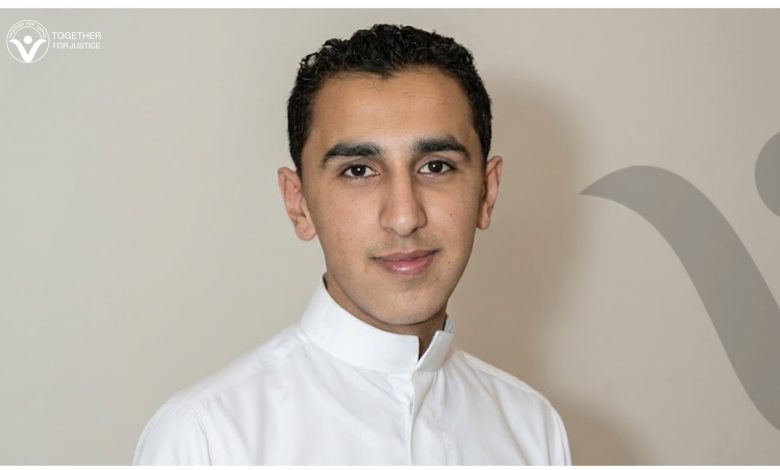
Together for Justice strongly condemns the imminent threat of execution facing Saudi citizen Youssef Al-Manasif, who was sentenced to death over allegations involving his participation in protests and funeral gatherings when he was between the ages of 15 and 17.
The organization issues an urgent warning to the Saudi authorities against carrying out this sentence, stressing that executing a person for alleged offences committed before the age of 18 would constitute a grave violation of international human rights law, an irreversible assault on the right to life, and a serious betrayal of Saudi Arabia’s publicly declared commitments to ending the death penalty for offences committed by children.
This urgent warning follows reports that the Saudi Supreme Court has upheld Al-Manasif’s death sentence, placing him at imminent risk of execution and making immediate international intervention essential.
Youssef Al-Manasif was arrested in 2017 and subsequently prosecuted before Saudi Arabia’s Specialized Criminal Court. The charges against him included participation in demonstrations and attendance at funeral gatherings during his teenage years, activities that were treated as security-related offences.
The violations surrounding his case extend far beyond the nature of the charges and the severity of the punishment.
According to human rights organizations documenting his case, Al-Manasif was subjected to physical and psychological torture and coerced into signing a false confession. He was also denied meaningful access to legal representation for years, meeting his state-appointed lawyer for the first time in 2022, approximately five years after his arrest.
The imposition of a death sentence following such serious allegations of torture, coerced confessions, and violations of fair trial guarantees raises profound concerns about the integrity of the judicial proceedings.
More fundamentally, imposing capital punishment for offences committed by a person under the age of 18 directly contradicts an unequivocal prohibition under international law.
No security justification, criminal accusation, or judicial decision can legitimize the execution of a person for an act committed during childhood.
An Absolute Prohibition Under International Human Rights Law
Article 37(a) of the Convention on the Rights of the Child, to which Saudi Arabia acceded in 1996, explicitly prohibits imposing the death penalty for offences committed by persons below 18 years of age.
This prohibition is absolute. It cannot be circumvented by reclassifying alleged offences as terrorism, national security violations, or any other category of criminal conduct.
Together for Justice stresses that the relevant legal consideration is the individual’s age at the time of the alleged offence, not their age at arrest, trial, sentencing, or execution.
Therefore, the fact that Youssef Al-Manasif is now an adult does not remove the protection guaranteed to him under international human rights law for acts allegedly committed when he was a child.
Any execution carried out in these circumstances would represent a serious breach of Saudi Arabia’s obligations under the Convention on the Rights of the Child and an arbitrary deprivation of life.
The organization further emphasizes that the use of the death penalty in cases involving peaceful protests, public gatherings, or other non-violent activities constitutes an additional and deeply troubling violation of international human rights standards.
UN Experts Have Already Called for His Release
Together for Justice recalls that the United Nations Working Group on Arbitrary Detention examined the case of Youssef Al-Manasif and four other individuals in Opinion No. 71/2024, adopted in November 2024.
The Working Group concluded that their detention was arbitrary, identifying serious violations involving the legal basis for their detention, the rights to freedom of expression and peaceful assembly, and fundamental fair trial guarantees.
The UN experts called for their immediate release, compensation and other forms of reparation, and an independent investigation into the violations they had suffered.
Furthermore, in September 2025, independent UN human rights experts warned Saudi Arabia against proceeding with executions of individuals convicted of offences allegedly committed before the age of 18.
They reiterated that such executions violate international law and constitute an arbitrary deprivation of life.
These findings make the current situation particularly alarming.
Saudi Arabia cannot claim that the legal implications of Al-Manasif’s case are unclear or that international concerns have not been communicated.
The authorities have already received explicit warnings and recommendations from United Nations human rights mechanisms. Proceeding with his execution would mean disregarding those findings and deliberately crossing a clear international legal boundary.
Saudi Arabia’s Reform Commitments Face a Critical Test
Together for Justice also recalls that Saudi Arabia announced reforms in 2020 aimed at ending the use of capital punishment for offences committed by children.
These measures were publicly presented as part of a broader modernization of the Saudi criminal justice system and improvements in the protection of fundamental rights.
However, the continued imposition and enforcement of death sentences in cases involving alleged offences committed during childhood expose a serious gap between official reform commitments and actual judicial practice.
Genuine judicial reform cannot be measured by government announcements, legislative promises, or international public relations campaigns.
It must be measured by the effective protection of human life, the absolute prohibition of torture, respect for fair trial guarantees, and full compliance with the prohibition against sentencing individuals to death for offences committed before turning 18.
The threat facing Al-Manasif must also be considered against the backdrop of Saudi Arabia’s escalating use of capital punishment.
In 2025, the kingdom carried out a record 356 executions, according to figures reported by human rights organizations and international media.
Executing another individual for alleged offences committed during childhood would deepen existing concerns about the Saudi justice system and further undermine the credibility of the authorities’ declared reform agenda.
The protection of children’s rights cannot be selective, and the prohibition of juvenile executions cannot depend on the political or security classification of a case.
A state cannot credibly claim to be reforming its justice system while retaining the power to execute individuals for acts committed when they were children.
An Urgent Appeal for International Intervention
Together for Justice stresses that the danger facing Youssef Al-Manasif requires immediate, coordinated, and decisive international action.
Expressions of concern alone are no longer sufficient when an individual’s life may be at imminent risk.
The organization therefore calls for the following urgent measures:
- Immediate suspension and permanent annulment of Youssef Al-Manasif’s death sentence, followed by his release in accordance with the findings and recommendations of the UN Working Group on Arbitrary Detention.
- Urgent intervention by the UN Secretary-General, the UN High Commissioner for Human Rights, and the UN Human Rights Council, including direct communication with the Saudi authorities and requests for explicit guarantees that the execution will not be carried out.
- Immediate action by the UN Special Rapporteur on extrajudicial, summary or arbitrary executions, the Special Rapporteur on torture, and the Committee on the Rights of the Child, using all available procedures within their respective mandates to prevent the execution.
- An independent and transparent investigation into allegations of torture, coerced confessions, and serious procedural violations during Al-Manasif’s arrest, interrogation, detention, and trial, with accountability for those responsible.
- Immediate diplomatic pressure from governments maintaining close political, economic, and security relations with Saudi Arabia, ensuring that the case is not dismissed as an internal judicial matter beyond international scrutiny.
- An immediate halt to all executions involving offences committed by persons under the age of 18, alongside a comprehensive and independent review of such cases and effective legal safeguards to ensure full compliance with the Convention on the Rights of the Child.
Together for Justice holds the Saudi authorities fully responsible for Youssef Al-Manasif’s life and safety.
The organization warns that carrying out his execution despite longstanding international objections and previous UN findings would constitute a grave and irreversible violation of international human rights law.
The Right to Life Must Prevail Over Political and Security Considerations
The case of Youssef Al-Manasif is not simply another death penalty case. It is a fundamental test of whether Saudi Arabia is prepared to respect its obligations to protect children and uphold the most basic guarantees of justice.
No individual should face execution for attending a protest, participating in a public gathering, or expressing an opinion peacefully, and no person may lawfully be sentenced to death for an offence committed before the age of 18.
Nor can any justice system claim legitimacy when serious allegations of torture, coerced confessions, and denial of legal representation remain unresolved in a case involving the irreversible punishment of death.
The international community must recognize that the urgency of this case leaves no room for prolonged diplomatic hesitation.
Every government, international institution, and human rights mechanism capable of influencing this decision has a responsibility to act before it is too late.
The life of Youssef Al-Manasif cannot be treated as a matter for delayed consideration. An execution cannot be reversed, and no compensation can restore a life unlawfully taken.
Together for Justice therefore reiterates its strongest warning to the Saudi authorities and calls on the United Nations and the international community to intervene without delay.
Saudi Arabia must immediately halt Youssef Al-Manasif’s execution, overturn his death sentence, and comply with its binding international obligations.
The world must act now — before another irreversible violation is committed in the name of justice.