Waleed Abu Al-Khair: Saudi Human Rights Lawyer Sentenced to 15 Years in Prison for Refusing to Abandon His Human Rights Work
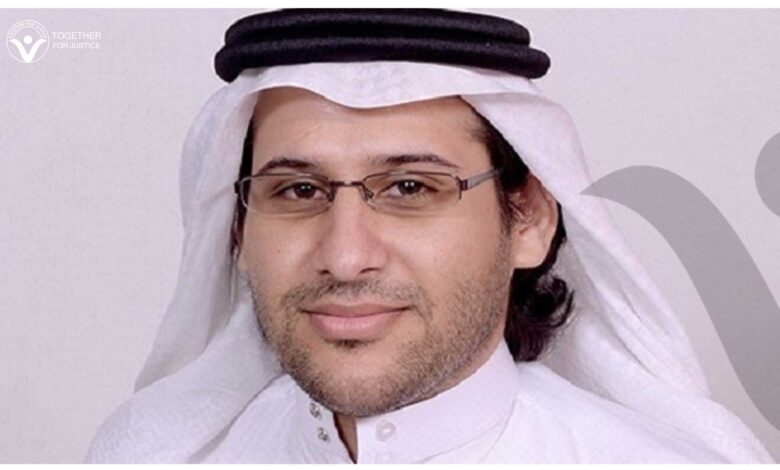
Together for Justice renews its call for the immediate and unconditional release of Saudi human rights lawyer Waleed Abu Al-Khair, who has spent more than twelve and a half years behind bars since his arrest on 15 April 2014, after refusing to sign a pledge to abandon his human rights activities.
Despite dedicating his career to defending victims of human rights violations, advocating for legal reform, and protecting fundamental freedoms, Abu Al-Khair was sentenced to 15 years in prison, followed by a 15-year travel ban and a fine of 200,000 Saudi riyals.
Together for Justice stresses that his continued imprisonment represents a serious violation of freedom of expression and the right to defend human rights. His case also illustrates the use of security legislation and criminal proceedings to punish lawyers and human rights defenders for their peaceful activities.
The organization remains deeply concerned about his safety and well-being, particularly in light of documented reports of solitary confinement, ill-treatment, restrictions on family contact, and inadequate medical care during his imprisonment.
Waleed Abu Al-Khair was not simply a lawyer representing individual clients. He was among Saudi Arabia’s most prominent independent human rights defenders. He founded the Monitor of Human Rights in Saudi Arabia, an organization dedicated to documenting violations, supporting prisoners of conscience, and advocating for judicial independence, civil liberties, and political rights.
His legal work included defending blogger Raif Badawi, supporting human rights activist Samar Badawi, and representing members of the Saudi Civil and Political Rights Association (ACPRA), also known as HASM.
He also used traditional media and social media platforms to expose arbitrary detention, challenge abuses committed by the authorities, and advocate for greater accountability and judicial reform.
However, his peaceful human rights work made him the target of repeated legal and security measures.
Saudi authorities demanded that he cease his activities and sign a written undertaking to abandon his human rights advocacy. Abu Al-Khair refused.
On 15 April 2014, he was arrested while attending a hearing in his own trial before the Specialized Criminal Court in Riyadh. His arrest marked a decisive escalation in the authorities’ campaign against one of the country’s most outspoken human rights lawyers.
He was subsequently prosecuted on broadly framed charges, including inciting public opinion, insulting the judiciary, damaging the reputation of the state, communicating with international organizations, and establishing an unauthorized organization. Other accusations related to his activities under Saudi Arabia’s Anti-Cybercrime Law.
These charges arose from his peaceful human rights work, public statements, and criticism of government practices. His activities were not linked to violence or incitement to violence.
Nevertheless, he was prosecuted before the Specialized Criminal Court under counterterrorism legislation.
On 6 July 2014, the court sentenced him to 15 years in prison, initially suspending five years of the sentence. It also imposed a 15-year travel ban following his release and a fine of 200,000 Saudi riyals.
In January 2015, the suspended portion of his sentence was reinstated after he refused to apologize for his human rights activities or renounce his positions, making the full 15-year prison term enforceable.
His refusal to abandon human rights advocacy therefore not only contributed to his imprisonment but also became a factor in the enforcement of a harsher punishment.
Together for Justice considers this case a deeply troubling example of the criminalization of independent human rights work in Saudi Arabia.
A lawyer must never be punished for representing victims of violations, criticizing unlawful practices, or cooperating with international human rights institutions.
Similarly, establishing independent human rights initiatives and calling for judicial reform cannot legitimately be treated as threats to national security.
The violations reportedly suffered by Abu Al-Khair did not end with his conviction.
Human rights organizations have documented periods of solitary confinement, sleep deprivation, restrictions on family visits, ill-treatment, and inadequate access to appropriate food and medical care during different stages of his imprisonment.
He also undertook hunger strikes to protest his detention conditions, including a strike in 2016 demanding appropriate food, medical treatment, and access to books.
In November 2019, he launched another hunger strike after being transferred to a high-security section of Dhahban Prison in Jeddah.
These concerns are particularly serious because Abu Al-Khair suffers from diabetes, a medical condition requiring regular monitoring, appropriate treatment, and a suitable diet.
Human rights reports have documented periods in which he was reportedly denied essential medical and dietary requirements, raising concerns about his health and safety.
Together for Justice emphasizes that withholding adequate healthcare from detainees, using prolonged isolation as punishment, or restricting family communication to exert pressure constitutes a violation of fundamental human rights.
Such practices cannot be justified by the nature of the charges or the length of a prison sentence.
Abu Al-Khair’s continued imprisonment is even more alarming because an independent United Nations human rights mechanism has already examined his case.
In Opinion No. 10/2018, the UN Working Group on Arbitrary Detention concluded that his deprivation of liberty was arbitrary and contrary to international human rights standards.
The Working Group called for his release and for appropriate compensation and other reparations.
Despite these findings, Saudi authorities have continued to hold him in prison for years, disregarding repeated international demands to end his detention.
Abu Al-Khair’s human rights work has also received significant international recognition.
He has been honoured with several prestigious human rights awards, including the Olof Palme Prize, the 2018 Right Livelihood Award, and the American Bar Association’s International Human Rights Award in 2019.
Yet international recognition has not secured his freedom.
More than twelve years after his arrest, Saudi society continues to be deprived of the contributions of a lawyer who dedicated his professional life to strengthening the rule of law, defending prisoners of conscience, and promoting judicial accountability.
Together for Justice stresses that Abu Al-Khair’s case extends beyond the suffering of a single individual.
It concerns the right of an entire society to have independent lawyers who can represent victims of injustice without fear of imprisonment, retaliation, or criminal prosecution.
When defending prisoners becomes a criminal offence, and advocating for fundamental rights is treated as a security threat, the consequences extend to every individual seeking legal protection.
The organization warns that Abu Al-Khair’s continued imprisonment, despite more than twelve years of detention and a clear UN finding of arbitrariness, raises serious questions about Saudi Arabia’s commitment to judicial reform and the protection of fundamental freedoms.
Genuine respect for the rule of law cannot coexist with the imprisonment of lawyers for carrying out peaceful human rights work.
Nor can counterterrorism legislation legitimately be used to silence independent legal professionals or punish them for refusing to abandon their principles.
Together for Justice renews its demand that Saudi authorities immediately and unconditionally release Waleed Abu Al-Khair, overturn his conviction, and cancel all associated penalties, including the travel ban and financial fine.
The organization also calls for full disclosure of his current health condition and detention circumstances, regular and unrestricted communication with his family and legal representatives, and access to appropriate medical treatment.
An independent investigation must be conducted into the reported ill-treatment, solitary confinement, and denial of adequate healthcare he has experienced, with accountability for those responsible.
Together for Justice further urges the Office of the United Nations High Commissioner for Human Rights, the Working Group on Arbitrary Detention, the Special Rapporteur on the independence of judges and lawyers, and the Special Rapporteur on the situation of human rights defenders to renew their efforts to secure his release and ensure implementation of the relevant UN recommendations.
International bar associations, legal organizations, and human rights institutions must also continue raising his case as an example of the dangers faced by lawyers who peacefully defend fundamental rights.
Waleed Abu Al-Khair was not imprisoned for committing an act of violence. He was imprisoned after refusing to abandon his work defending human rights, challenging injustice, and advocating for legal reform.
More than twelve and a half years of his life have already been spent behind bars, under a 15-year sentence imposed on a lawyer who refused to apologize for defending human rights.
His continued imprisonment does not punish one lawyer alone. It sends a warning to everyone who believes in peaceful advocacy, legal accountability, and the right to challenge injustice.
Defending human rights is not a crime, and fifteen years of imprisonment must never be the price of standing up for justice. Together for Justice demands the immediate and unconditional release of Waleed Abu Al-Khair.