
Ahmed Al-Doush: British-Sudanese Citizen Detained in Saudi Arabia Despite UN Finding His Detention Arbitrary and Calling for His Release
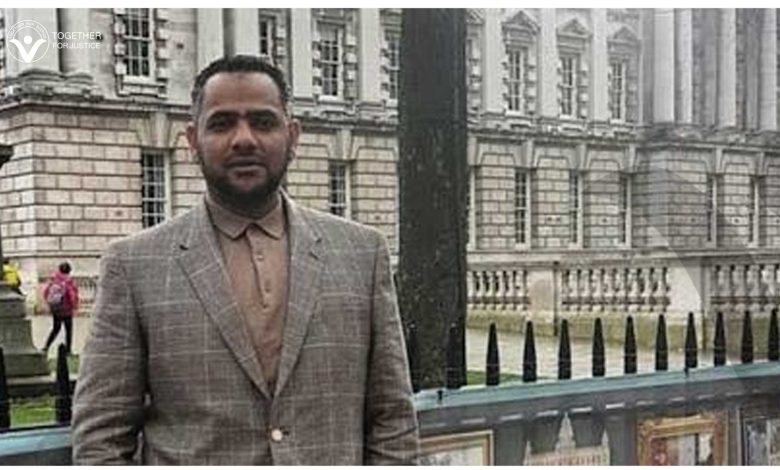
Together for Justice condemns the continued detention of British citizen of Sudanese origin Ahmed Al-Doush, who has been held in Saudi Arabia since his arrest at King Khalid International Airport in Riyadh on 31 August 2024 while returning to the United Kingdom after visiting Saudi Arabia with his wife and children. His continued separation from his family, despite a clear UN finding that his detention is arbitrary and that he should be released and compensated, represents a serious violation that must not be ignored.
Al-Doush, a business analyst based in the United Kingdom, was arrested as he was preparing to return home. Since then, what began as a family trip has turned into a security-related case that has kept him away from his wife and children and placed him in a judicial process marked by serious concerns over arbitrariness, lack of fair trial guarantees, and the misuse of counterterrorism frameworks to punish peaceful expression.
According to available human rights information, the case is linked to old social media posts and an alleged association with a critic of the Saudi government abroad. The UN Working Group on Arbitrary Detention concluded that Al-Doush’s detention was based on his exercise of freedom of expression through social media and his perceived association with a critic of the Saudi government, finding his detention arbitrary under international law and calling for his immediate release.
The core of the case exposes a dangerous pattern in Saudi Arabia: old posts, a limited online presence, or alleged social association can be transformed into a security file before the Specialized Criminal Court. This court has long been linked to the prosecution of prisoners of conscience and the use of terrorism and state security language against people who peacefully exercised their right to expression. Amnesty International reported that Al-Doush was tried over charges based on social media use and that his sentence was later reduced to five years on appeal.
Together for Justice stresses that turning peaceful online expression into a “terrorism” case is a grave violation of proportionality and a clear abuse of security legislation. Peaceful speech, even when critical or related to public political issues, must not lead to arrest, trial before an exceptional court, or severe prison sentences against a person who is not accused of any violent act.
The concern is compounded by reports about Al-Doush’s deteriorating mental well-being in prison, restrictions on his communication with his family, and the authorities’ failure to fully share court documents and judgments with his relatives. Amnesty International has stated that his mental well-being has deteriorated significantly in detention and that Saudi authorities have not shared court documents, including trial and appeal judgments, with his family.
Al-Doush’s detention affects not only him, but also his family. He was arrested while travelling with his wife and children, and his wife was pregnant with their fourth child at the time. Since then, he has been deprived of his normal presence in his family’s life and separated from his children. This human dimension is inseparable from the legal one: the punishment has effectively extended to his family, who have endured more than two years of anxiety, absence, and uncertainty.
Together for Justice considers Saudi Arabia’s continued detention of Al-Doush, despite the UN Working Group’s opinion, a direct challenge to international human rights mechanisms. When an independent UN body concludes that a detention is unlawful and calls for release and compensation, ignoring that finding demonstrates the authorities’ determination to punish expression rather than remedy the violation.
The organization also criticizes the weakness of the United Kingdom’s public response compared with the gravity of the case. Al-Doush is a British citizen, and his arbitrary detention abroad requires a clear and firm public position from the UK government, not only general diplomatic engagement. Amnesty International has called on the UK government to do more to secure his release, especially after a year of detention and in light of the UN finding that his detention is arbitrary.
Together for Justice holds the Saudi authorities fully responsible for Ahmed Al-Doush’s physical and psychological safety. The organization calls for his immediate and unconditional release in line with the UN Working Group on Arbitrary Detention’s opinion, compensation for the period of arbitrary detention he has endured, and his safe return to his family in the United Kingdom.
The organization also calls for full disclosure of his case documents, urgent access to appropriate medical and psychological care pending release, and regular, unrestricted contact with his family and legal counsel.
Together for Justice urges the UK government to take a clearer and more public position, and to use all available diplomatic and legal tools to press for his release. Protecting citizens from arbitrary detention abroad must not be subordinated to political or economic considerations. It must be guided by a basic principle: no citizen should be left behind bars over old posts or peaceful expression.
Ahmed Al-Doush’s case again shows how, in Saudi Arabia, words online can become a prison sentence, and a foreign national can be separated from his wife and children over accusations not based on violence or any genuine crime. After a clear UN opinion calling for his release and compensation, his continued detention is not only a Saudi violation; it is a test of the international community’s seriousness in defending freedom of expression and opposing arbitrary detention.